What Is a Halo Ring? Settings, Styles and Pros and Cons
“A halo ring frames the centre stone in a ring of smaller diamonds. The setting's history, the main types including hidden halos, and the honest trade-offs.”

AI-generated illustration; not a Shewah product or a scale measurement.
SHEWAH Editorial Concept Illustration (Non-Catalogue)
A halo ring is a ring whose centre stone is framed by a circle of smaller accent stones, usually diamonds. From above, that ring of accents reads as a rim of light around the main stone, which is exactly where the setting gets its name.
The halo is one of the most requested engagement ring settings in the US, UK and Australia, and one of the easiest to customise. Here is what it is, the main variations, and the honest trade-offs.
What defines a halo setting
Every halo ring has two parts: a centre stone and a ring of smaller stones, called melee, that follows its outline. The centre stone is most often a round, oval, cushion or princess cut. The halo itself is usually pavé-set diamonds, though coloured gemstones work just as well.
A short history of the halo
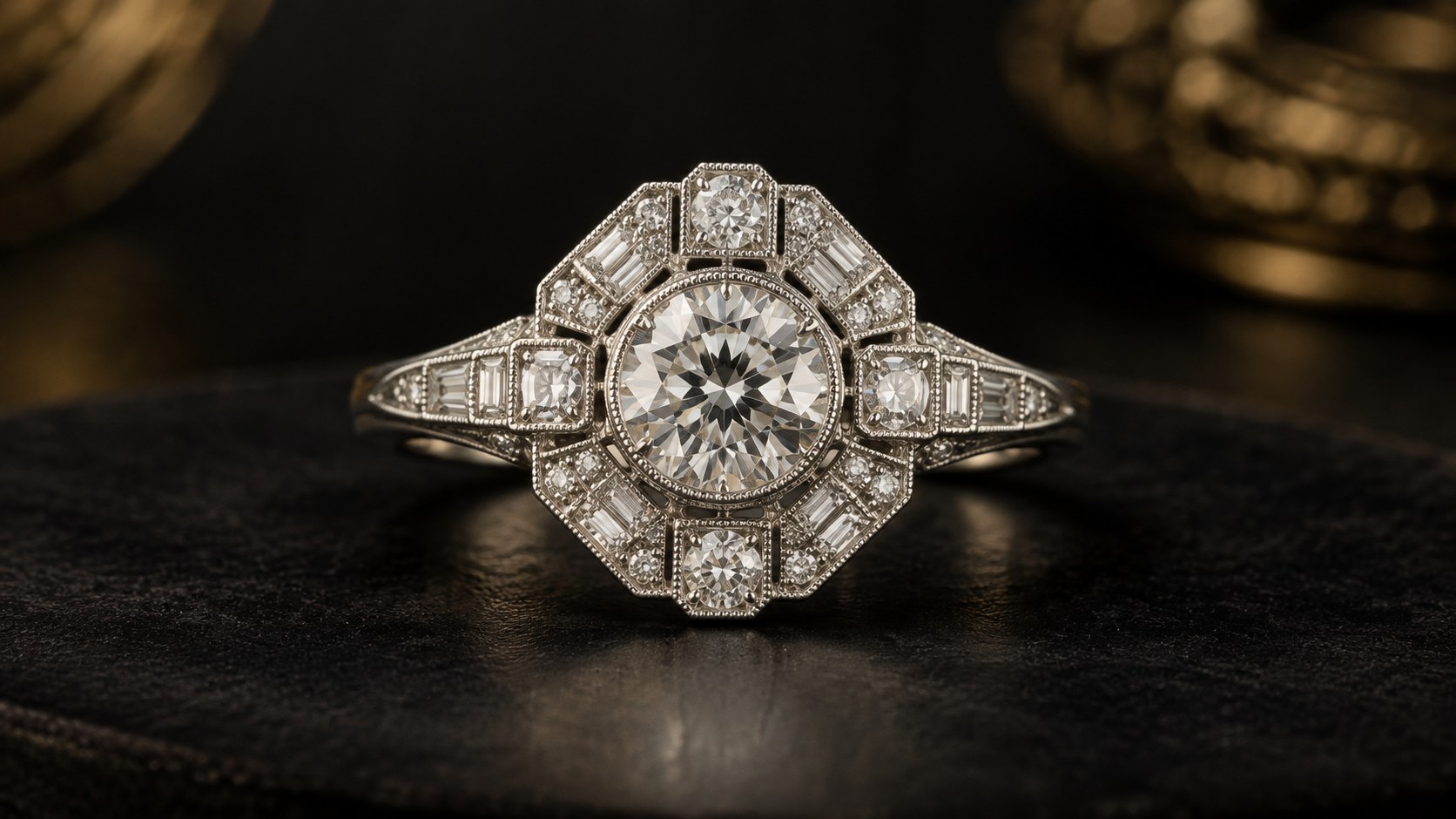
According to Blue Nile, halo designs have vintage origins in the Georgian era (1714 to 1837), when jewellers built intricate floral patterns from small stones. The style surged again in the Art Deco period of the 1920s, which suited its geometry and symmetry, and it has stayed a classic ever since.
Types of halo settings
- Single halo. One row of accent stones around the centre. The most common style.
- Double halo. Two rows of accents, for a larger, more lavish outline.
- Halo with pavé band. Accents around the centre stone plus diamonds along the band.
- Halo with cathedral setting. The band slopes upward on both sides to support the centre stone.
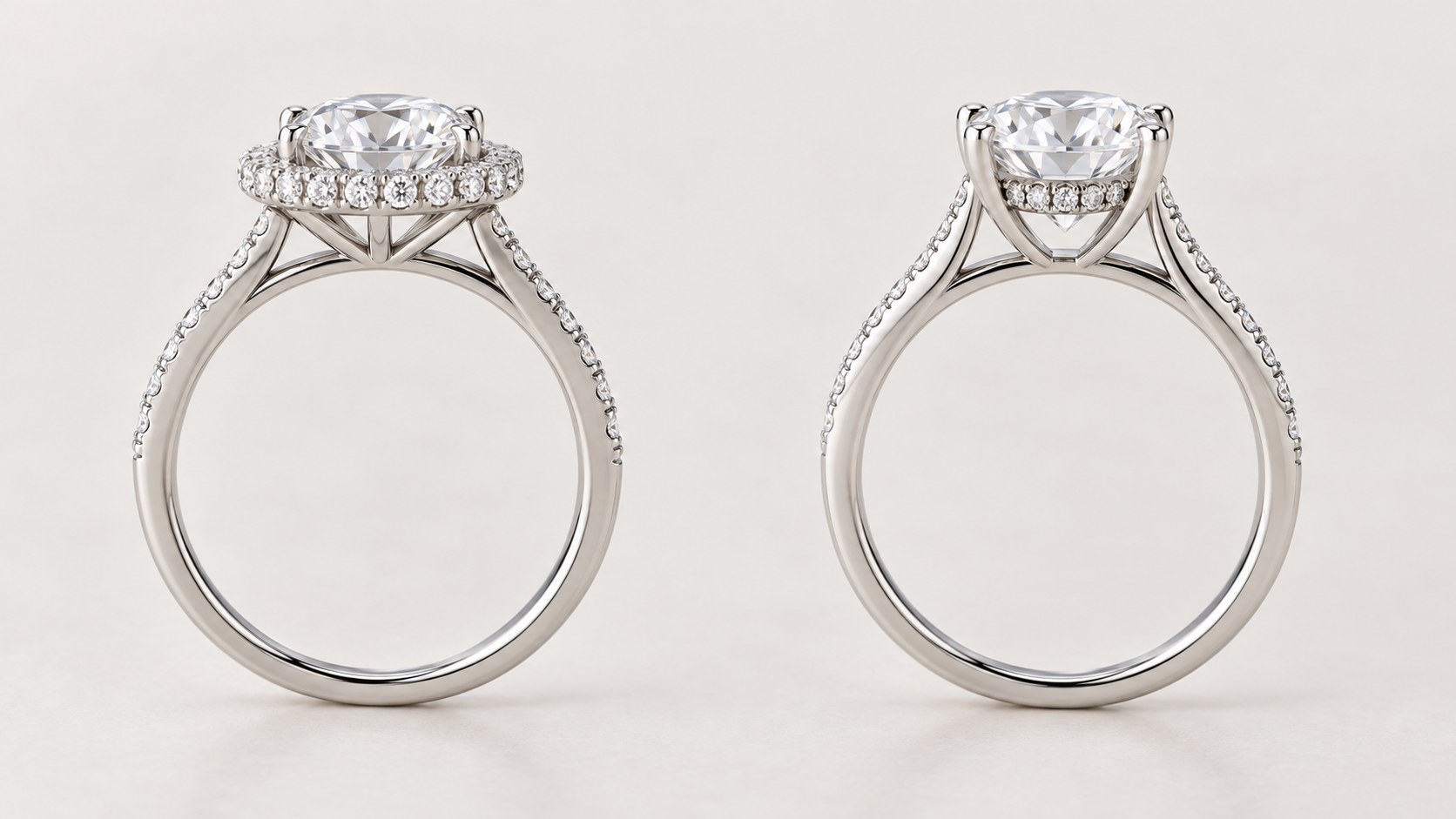
- Hidden halo. The accent stones sit beneath the centre stone, near the base of the prongs, so they are mostly visible from the side rather than from above.
- Hybrid. A visible halo and a hidden halo together, for sparkle from every angle.
AI-generated illustration; not a Shewah product or a scale measurement.
SHEWAH Editorial Concept Illustration (Non-Catalogue)
Halo vs hidden halo
| | Halo | Hidden halo | | --- | --- | --- | | Accent placement | Around the centre stone | Beneath the centre stone | | Top view | Fully visible | Not visible | | Side view | Visible | Highly visible | | Look | Classic, bold | Modern, subtle | | Snag risk | Higher | Lower | | Cleaning | Standard | Traps oils, needs more attention | | Wedding band fit | May need a curved band | Usually sits flush | | Price | Higher (more stones) | Lower |
Why people choose a halo
- It makes the centre stone look larger. The accent border extends the stone's outline, so a modest centre diamond reads bigger from the top.
- More sparkle from every angle. Dozens of extra facets catch light that a plain band would not.
- It protects the centre stone. The halo shields the stone's edges from knocks.
- Budget stretch. Because the halo adds presence, a smaller centre stone still looks substantial, and lab-grown diamonds bring the total cost down further.
What to consider
- More maintenance. More stones means more tiny prongs, so the ring benefits from regular cleaning and an annual professional check.
- A busier look. If you prefer minimal, a solitaire or a hidden halo may suit you better.
- Wedding band pairing. A flat band may not sit flush against a visible halo. Plan the pairing early, or have a curved band made to contour around it.
Choosing your halo ring
- Centre stone shape. Round is the classic; oval, cushion and princess cuts all pair well.
- Visible or hidden. Bold outline, or a clean top view with sparkle from the side.
- Metal. Yellow gold for warmth, white gold or platinum for a seamless white-on-white look, rose gold for softness.
- Lifestyle. If your hands work hard, a lower profile or hidden halo snags less.
- The band. Decide on the wedding band at the same time so the two sit together properly.
Create a halo ring with Shewah
Send us a centre stone shape and a style you like, and we will prepare a made-to-order halo or hidden halo design with lab-grown diamonds, quoted before work begins.
Explore Shewah's jewellery, or contact us on WhatsApp at +91 96622 66360 to design a custom halo ring.
AI-generated illustration; not a Shewah product or a scale measurement.
SHEWAH Editorial Concept Illustration (Non-Catalogue)
Sources
The Maison Shewah Atelier Standard
Every creation referenced across our journal essays is made individually to order using solid 18K gold and independently certified diamonds (IGI & GIA). We uphold complete material transparency and zero synthetic plating.
Research & Gemological References
- [1]Comparing Halo and Solitaire Engagement Ring Settings — With Clarity (Verified: 2026-10-13)
- [2]Halo vs. Hidden Halo: How To Choose the Right Ring Setting — Blue Nile (Verified: 2026-10-13)


