What Is a Cluster Ring? Design, History and Buying Tips
“A cluster ring builds its sparkle from many small stones instead of one large one. The style's 300-year history, and what to check before buying.”

AI-generated illustration; not a Shewah product or a scale measurement.
SHEWAH Editorial Concept Illustration (Non-Catalogue)
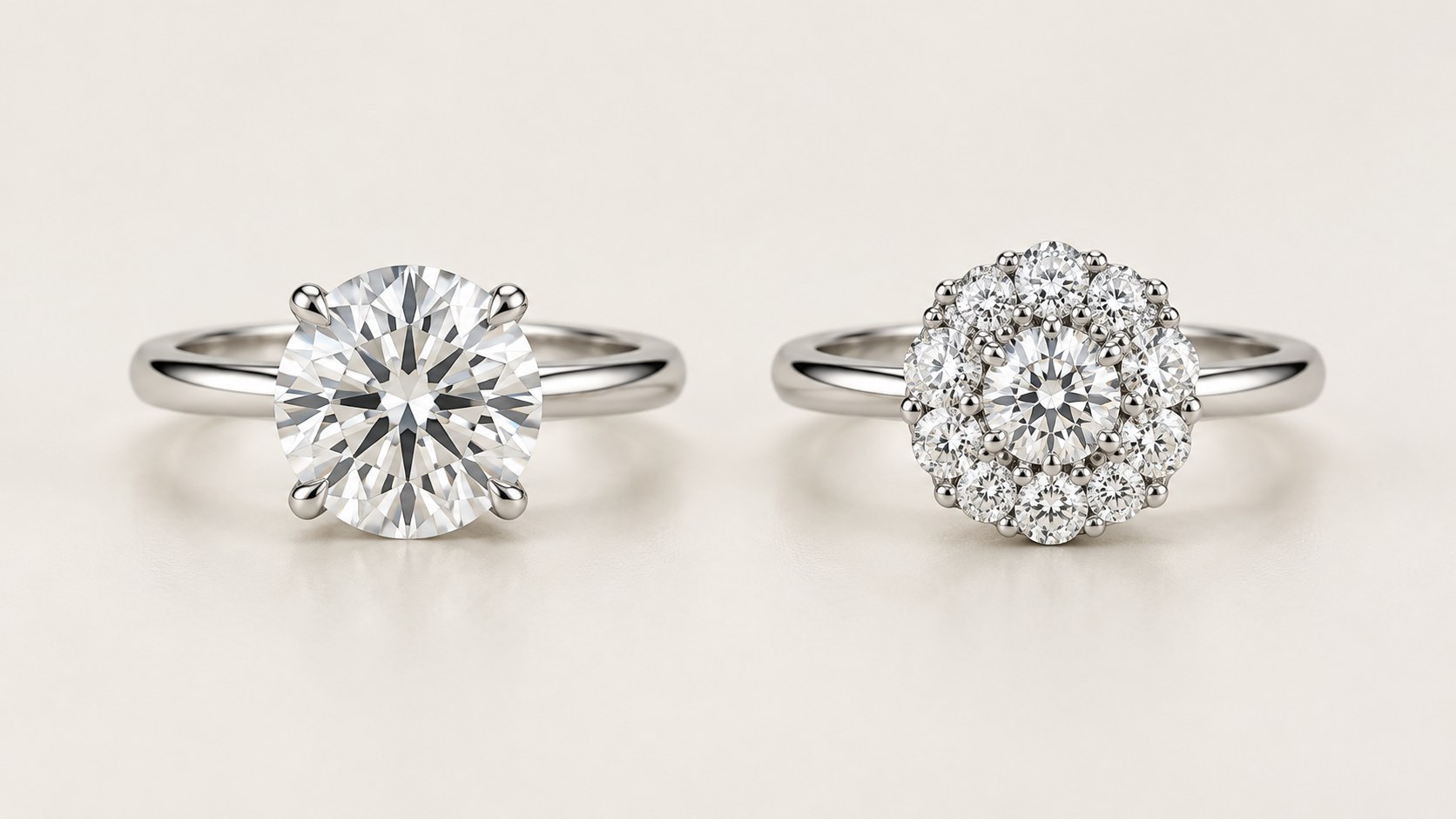
A cluster ring is a ring where a group of small stones is set closely together so they read as one sparkling shape. Instead of a single large diamond doing all the work, a cluster shares it across many small ones, and the effect can be bigger, brighter and far more personal.
Cluster engagement rings are having a real moment in the US, UK and Australia. Here is what defines the style, where it came from, and what to know before choosing one.
The two types of cluster ring
Designer Melanie Casey, speaking to The Knot, splits cluster rings into two families:
- True clusters. Many small stones, diamonds or coloured gemstones, grouped in symmetrical or more organic, free-flowing arrangements. There is no obvious centre stone; the cluster itself is the design.
- Focal-stone clusters. A traditional centre stone, like a solitaire, with clusters of smaller stones around it or along the band to enhance it. Halos and pavé styles live in this family.
Cluster vs solitaire
A solitaire puts one stone at the centre of everything. A cluster builds the same presence from many smaller stones, and that changes the maths and the look:
- Price. Small diamonds cost far less per carat than one large stone, partly because they are often byproducts of cutting bigger diamonds. A cluster arranged in the shape of a solitaire can deliver the same visual size for meaningfully less.
- Carat weight. Cluster rings are quoted in total carat weight (TCW), the combined weight of every stone. A "1 carat cluster ring" means all the small stones together weigh one carat, not that any single stone does.
- Clarity leeway. Because the stones are small and the arrangement is busy, minor inclusions disappear into the whole. You can comfortably choose a lower clarity grade than you would for a solitaire.
- Uniqueness. No two clusters need to look alike. Casey notes that people choose clusters precisely because they do not want a ring that looks like their friend's ring.
A short history of the cluster ring
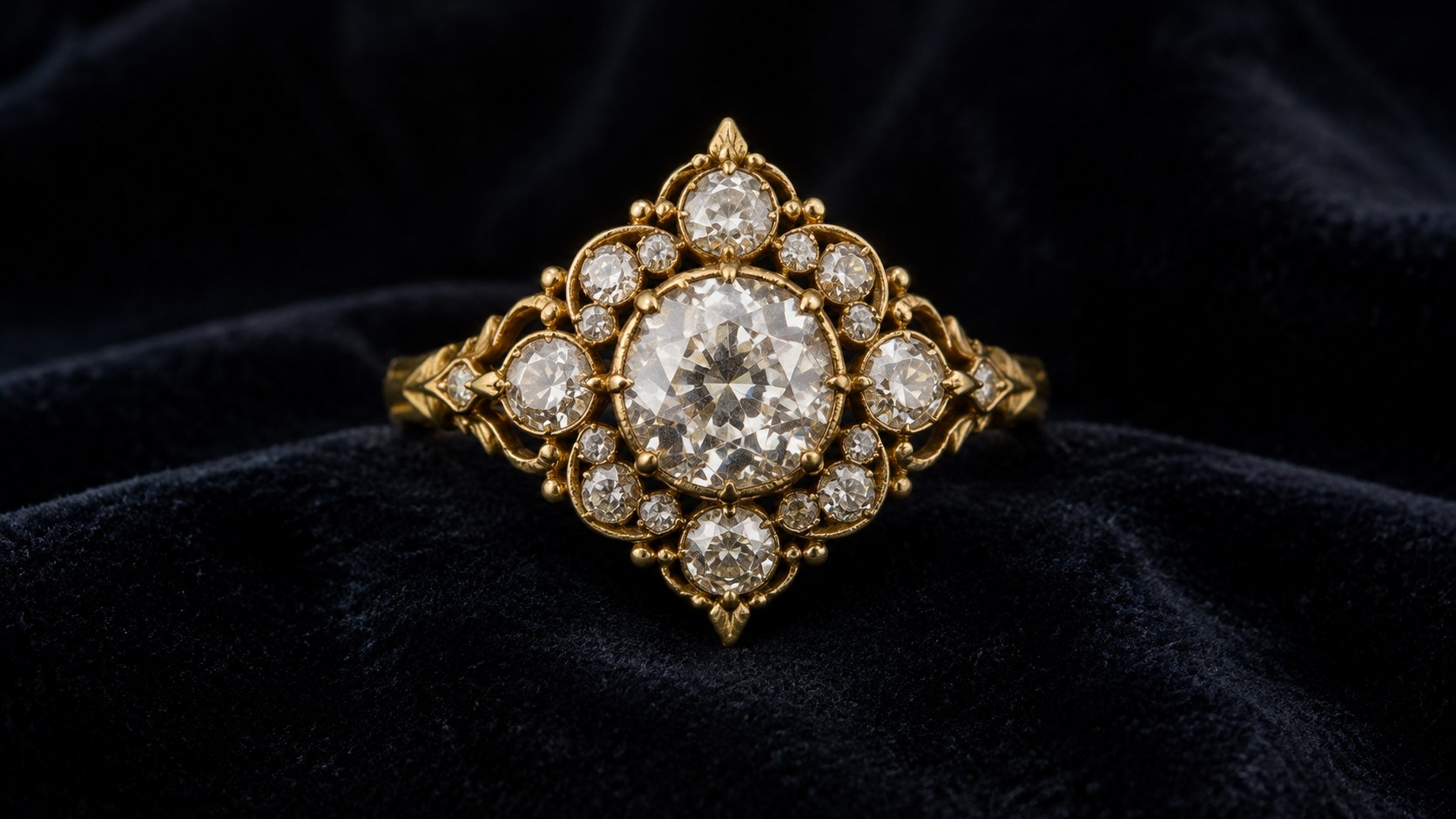
Cluster rings first emerged in the Georgian period (1714 to 1837), usually a central diamond surrounded by smaller stones in symmetrical patterns, most often in yellow gold. Victorian clusters turned delicate and floral, in step with the century's romantic mood. Edwardian designs borrowed from Art Nouveau, the Art Deco 1920s and 30s brought geometry and platinum, and today's clusters range from antique-style ornament to clean, minimal solitaire illusions.
AI-generated illustration; not a Shewah product or a scale measurement.
SHEWAH Editorial Concept Illustration (Non-Catalogue)
Meaning you can build in
Cluster rings carry symbolism unusually well, because the stones can be counted. Casey describes clients choosing a stone for each child, or for the number of dates before a couple said "I love you". Coloured gemstones add another layer: a ruby or sapphire cluster brings its own meaning alongside the design.
Popular cluster styles
- Solitaire-illusion clusters, where small stones are arranged in the outline of a round, oval, pear or heart-shaped single stone.
- Floral and sunburst clusters, with stones radiating like petals or rays.
- Halo clusters, a central cluster ringed by another circle of small stones.
- Trilogy and side-stone clusters, where grouped accents support a focal stone.
- Coloured gemstone clusters, mixing diamonds with sapphires, emeralds or rubies.
What to check before you buy
- Craftsmanship. Clusters are among the hardest rings to set well. Every small stone needs its own secure seat, and a poorly executed cluster looks jumbled rather than intentional. Choose a jeweller with proven cluster work, and expect an annual prong check.
- Total carat weight vs single stone. Compare like with like: TCW is not the same as a one-carat solitaire, which is precisely where the saving comes from.
- Settings. Prong settings let in the most light; pavé settings create a more continuous, cobblestone surface.
- Lifestyle. Intricate vintage-style clusters with sharp angles can snag on clothing. If your hands are active, look for a smooth, rounded outline.
- Care. Soak in warm water with a little mild washing-up liquid for up to half an hour, brush gently with a soft toothbrush, and dry with a soft cloth.
Create a cluster ring with Shewah
Cluster rings are where custom design shines brightest. Send us a silhouette, a number of stones that means something to you, or a coloured gemstone you love, and we will prepare a made-to-order cluster design with lab-grown diamonds, quoted before work begins.
Explore Shewah's jewellery, or contact us on WhatsApp at +91 96622 66360 to design a custom cluster ring.
AI-generated illustration; not a Shewah product or a scale measurement.
SHEWAH Editorial Concept Illustration (Non-Catalogue)
Sources
The Maison Shewah Atelier Standard
Every creation referenced across our journal essays is made individually to order using solid 18K gold and independently certified diamonds (IGI & GIA). We uphold complete material transparency and zero synthetic plating.
Research & Gemological References
- [1]Cluster Engagement Rings Are Trending - Here Are the Need-to-Knows — The Knot (Verified: 2026-10-13)
- [2]Cluster Diamond Engagement Ring Guide — Austen & Blake (Verified: 2026-10-13)


