How to Match a Wedding Band to Your Engagement Ring
“Compare straight, curved and contoured wedding bands. Check setting clearance, millimetre dimensions and fit before approving your ring pairing.”

AI-generated illustration; not a Shewah product or a scale measurement.
SHEWAH Editorial Concept Illustration (Non-Catalogue)
A wedding band does not have to match your engagement ring exactly. It does need to work with the way you want to wear the two rings: close together, with a deliberate gap, or separately.
Start with the engagement ring's setting and side profile, not just the centre-stone shape. Those details help determine whether a straight band can sit beside it or whether a curved design is worth considering.
This guide explains how to compare a pairing, what to measure and what to confirm before approving a custom wedding band.
Decide what "matching" means to you
Some people want the same metal colour and similar proportions. Others prefer a plain band beside a detailed engagement ring, or a contrasting metal colour.
There is no compulsory visual match. Tell your jeweller which parts matter: the colour, the band width, a repeated design detail or the way the rings meet.
If you use an inspiration photograph, explain what you like about it. A photograph can suggest a style, but it cannot establish that the same band will fit your particular engagement ring.
Understand a flush fit
A flush fit generally means the rings sit close together without a visible gap. It describes the relationship between the two pieces, not a guarantee attached to a wedding band on its own.
An engagement ring's head, basket or other setting details can prevent a straight band from sitting close to its shank. Brides and Brilliant Earth's pairing guides both explain that setting height and clearance affect the result.
Do not decide from the top view alone. Ask for a side view with the two rings together. A setting that looks compact from above may extend into the space where the wedding band would sit.
A gap is not automatically a problem
You may enjoy seeing the two rings as separate pieces. If so, a visible space can be part of the design rather than something to eliminate.
Try the arrangement on the intended finger and see how it feels. A gap in a still photograph does not tell you whether the rings move comfortably or how their settings interact during wear.
If you do want a close pairing, say so before choosing the band. It is easier to assess the intended arrangement during design selection than to discover after delivery that your expectations were different.
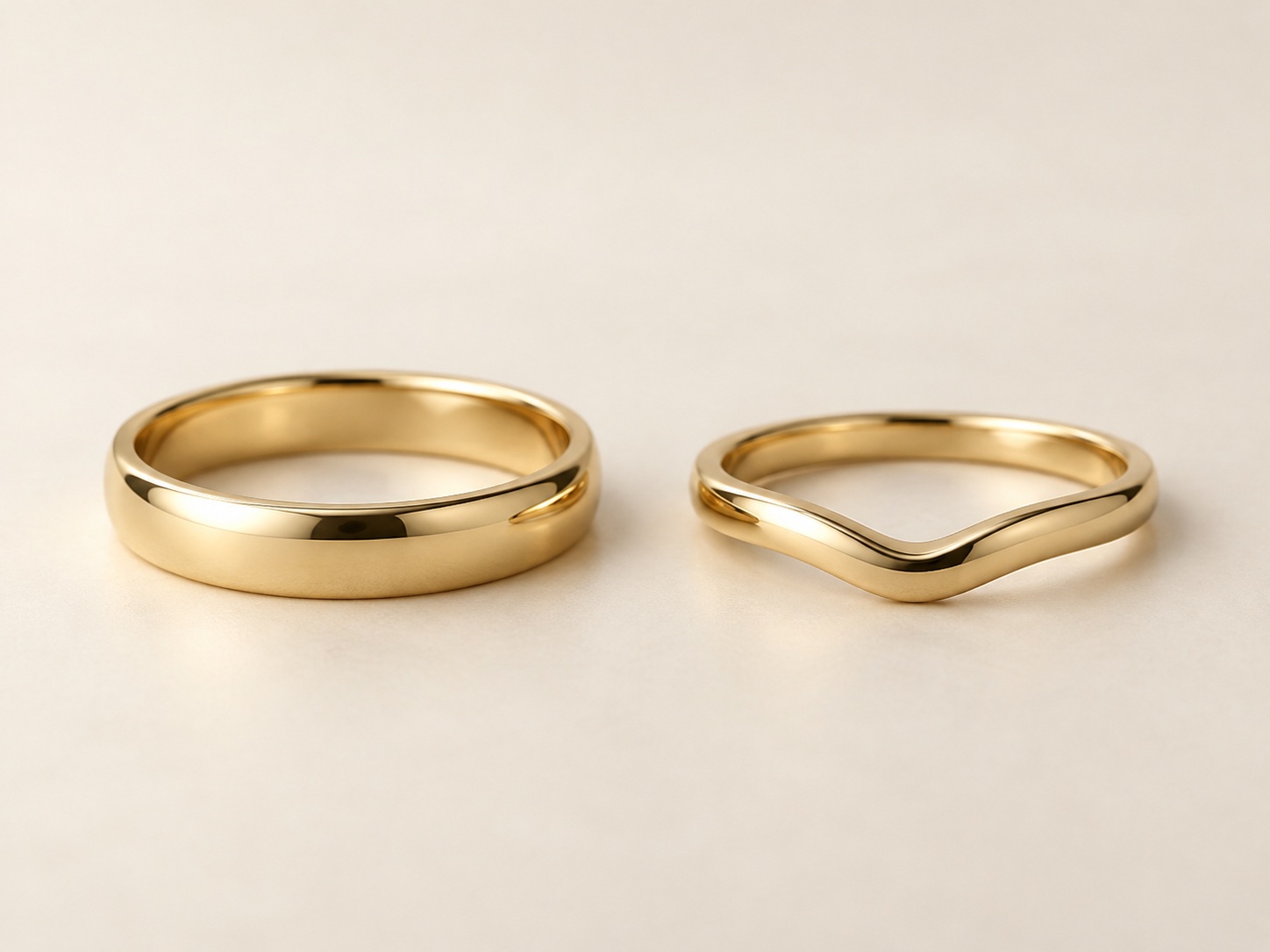
AI-generated illustration; not a Shewah product or a scale measurement.
SHEWAH Editorial Concept Illustration (Non-Catalogue)
Straight wedding bands
A straight band is a useful first option to compare. Depending on the engagement ring's construction, it may sit close to the shank or leave a gap around the setting.
Do not assume every raised solitaire will accept every straight band. The band's width and thickness, the setting's underside and the position of any accent stones still matter.
Ask the jeweller to test the actual combination where possible. For an online order, request a clear side-profile comparison and explain whether you are working from photographs or from the physical ring.
Curved and contoured bands
A curved or contoured band is shaped to follow part of the engagement ring's outline. It can be worth considering when a straight band cannot sit as close as you want.
The curve needs to suit the actual ring. A generic band described as "for oval rings" does not prove compatibility with every oval setting.
Look at the contoured band on its own too. If you expect to wear it without the engagement ring, decide whether you enjoy that shape as a separate piece. A very specific custom contour may feel different alone.
Notched and other shaped designs
Brides describes a notched band as another way to create room for a setting while retaining much of a straight outline. Other designs use an opening or a more pronounced curve.
Treat these as options to inspect, not universal solutions. Ask where the engagement ring will sit, how the band feels on the finger and which views you will review before approval.
A descriptive name is less useful than the agreed dimensions and design. The jeweller should explain what is being changed to accommodate your ring and what the final arrangement will look like.
Oval, pear and other elongated stones
An elongated stone can extend beyond the band, but the stone shape alone does not settle the pairing. Two oval engagement rings can have different baskets, heights and shoulder details.
Bring the side profile into the comparison. Ask whether the wedding band clears the underside of the setting and whether you want a curve that echoes the stone's outline.
Avoid treating a shape chart as a fit guarantee. Use it to choose styles to try, then check the actual rings together.
Compare width and metal details
Ask for each band's width and thickness in millimetres. A close-up photograph can make a slim band appear much broader than it is.
Choose proportions you enjoy, then check the combined feel. Two individually comfortable rings may feel different as a stack. Have the intended finger measured with the planned widths in mind.
If you mix metals, confirm the actual alloys rather than only their colour. Ask the jeweller to assess contact points and care for the specific combination. Do not assume matching colours mean identical materials or that contrasting colours alone create a problem.
Prepare a useful custom-band brief
Give the jeweller the engagement ring's details and clear photographs from above, from the side and underneath. Include measurements in millimetres where available.
Explain whether the physical ring can be inspected. If it cannot, ask which parts of the fit remain uncertain and how those uncertainties will be resolved before production.
A useful brief includes:
- Whether you want a close fit or a deliberate gap.
- Whether the wedding band should look good alone.
- The preferred metal alloy, colour and finish.
- The intended finger, sizing system and measurement method.
- Any stones, engraving or design details you want.
- Your budget and required delivery date.
Ask for a written summary of the agreed design. Do not treat an AI illustration as proof of exact clearance or manufacturing feasibility.
Review before ordering
Look at the top, side and underside views of the proposed pairing. Confirm which details are exact and which images are illustrative.
Ask about price, delivery, design changes, alteration options and return terms for the particular order. Do not assume the band can be resized or reshaped later without limits or additional cost.
For engraving, review the spelling and date separately. Keep the final ring specifications together so you can compare the finished piece with what you approved.
Frequently asked questions
Does my wedding band have to be the same metal colour?
No. Matching and contrasting colours are both styling choices. Confirm the actual alloys and ask the jeweller to assess the intended combination.
Will a curved band fit every low-set ring?
No. The curve must suit the setting's shape and dimensions. Check the actual pairing rather than relying on a category label.
Can I buy the wedding band later?
Yes. You can choose it after the engagement ring, but allow time to compare the fit and confirm any custom work. Ask for an actual timeline rather than assuming a standard delivery period.
Should I permanently join the two rings?
Discuss the implications with a jeweller before choosing that option. Confirm how it affects wearing them separately, cleaning, fit and later alterations. Do not assume it is necessary for a coordinated look.
What if I am ordering from another country?
Label the sizing system and share millimetre measurements where available. Ask for written confirmation of the final size, design and delivery terms for your destination.
Plan your wedding-band pairing with Shewah
Share the engagement ring's side profile, your preferred band style and the way you want to wear the two rings. A clear brief helps separate a visual idea from a fit that still needs checking.
Explore Shewah's jewellery, or contact us on WhatsApp at +91 96622 66360 to discuss a custom wedding-band design.
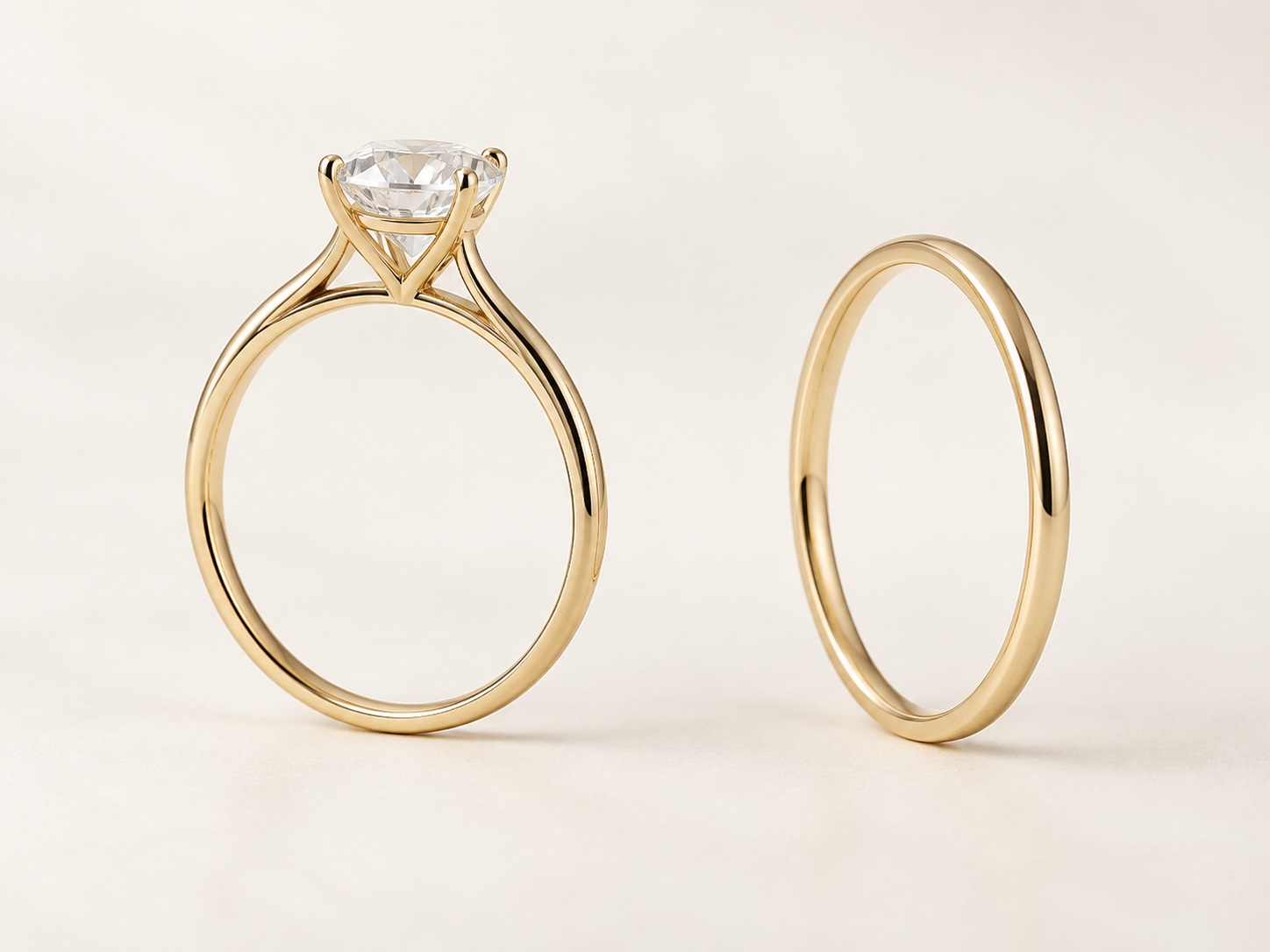
AI-generated illustration; not a Shewah product or a scale measurement.
SHEWAH Editorial Concept Illustration (Non-Catalogue)
Sources
The Maison Shewah Atelier Standard
Every creation referenced across our journal essays is made individually to order using solid 18K gold and independently certified diamonds (IGI & GIA). We uphold complete material transparency and zero synthetic plating.
Research & Gemological References
- [1]Brides: How to Match a Wedding Band to Your Engagement Ring — Brides (Verified: 2026-10-12)
- [2]Brilliant Earth: How to Choose a Wedding Band — Brilliant Earth (Verified: 2026-10-12)
- [3]GIA: Ring Size Guide — GIA (Verified: 2026-10-12)


