Earring Backs Explained: Butterfly, Screw, Flat Back and More
“How each earring back works, how secure it really is, and which one belongs on your studs, hoops and drops.”
AI-generated illustration; not a Shewah product or a scale measurement.
SHEWAH Editorial Concept Illustration (Non-Catalogue)
The back of an earring is the least photographed and most consequential part of the design. It decides whether the earring sits flat or droops, whether it survives a scarf change, and whether it is still on your ear at the end of the day. Most people learn the names only after losing an earring they loved. This guide saves you the lesson.
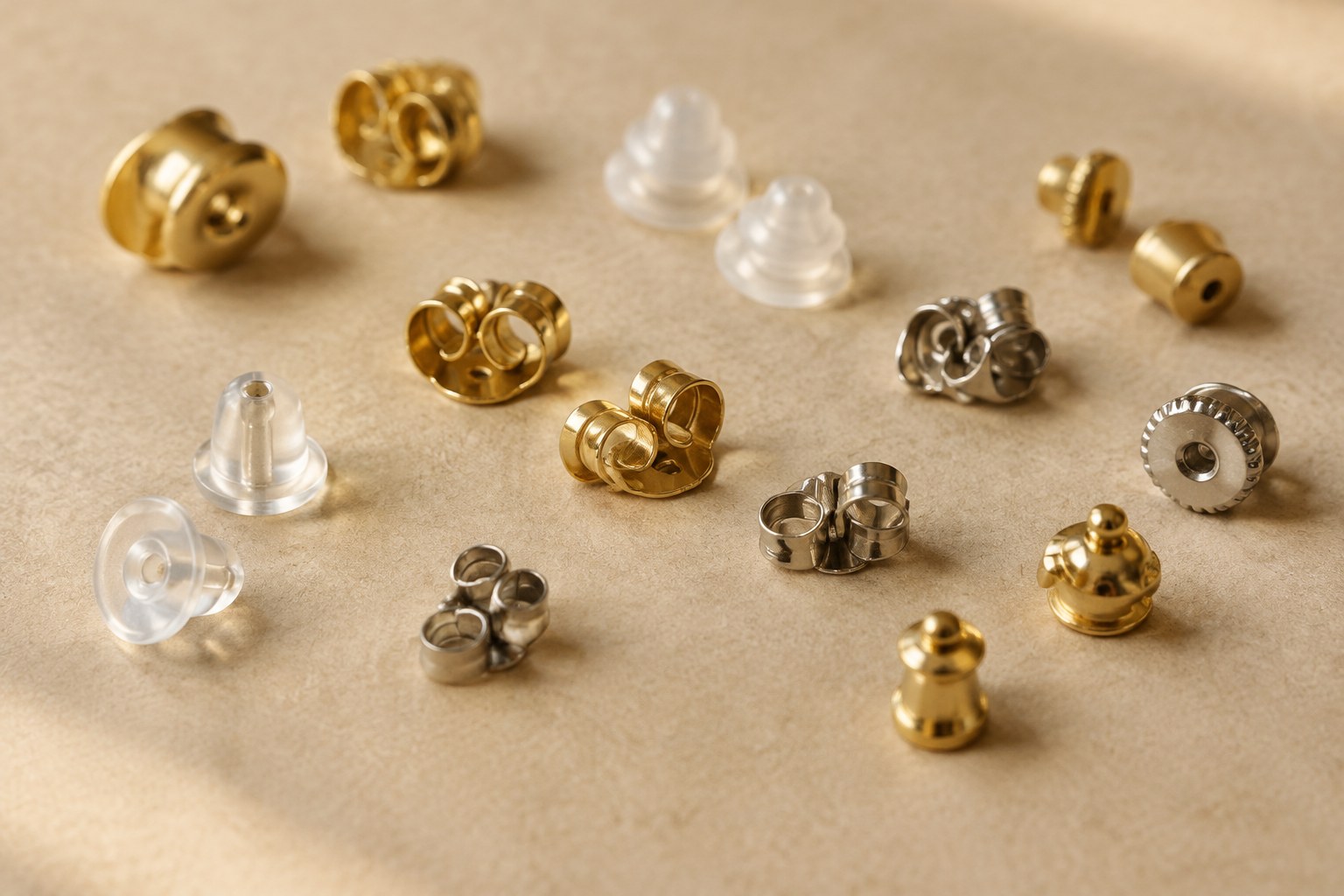
The butterfly back
Also called a friction back or push back, the butterfly is the small scrolled metal disc that slides onto a straight post. It is the default for stud earrings worldwide: light, inexpensive to replace and quick to fasten. Its weakness is tension - the scroll loosens with use, so give it a gentle squeeze every few months, and replace backs that slide on without resistance. For anything valuable, check the grip each time you put the pair on.
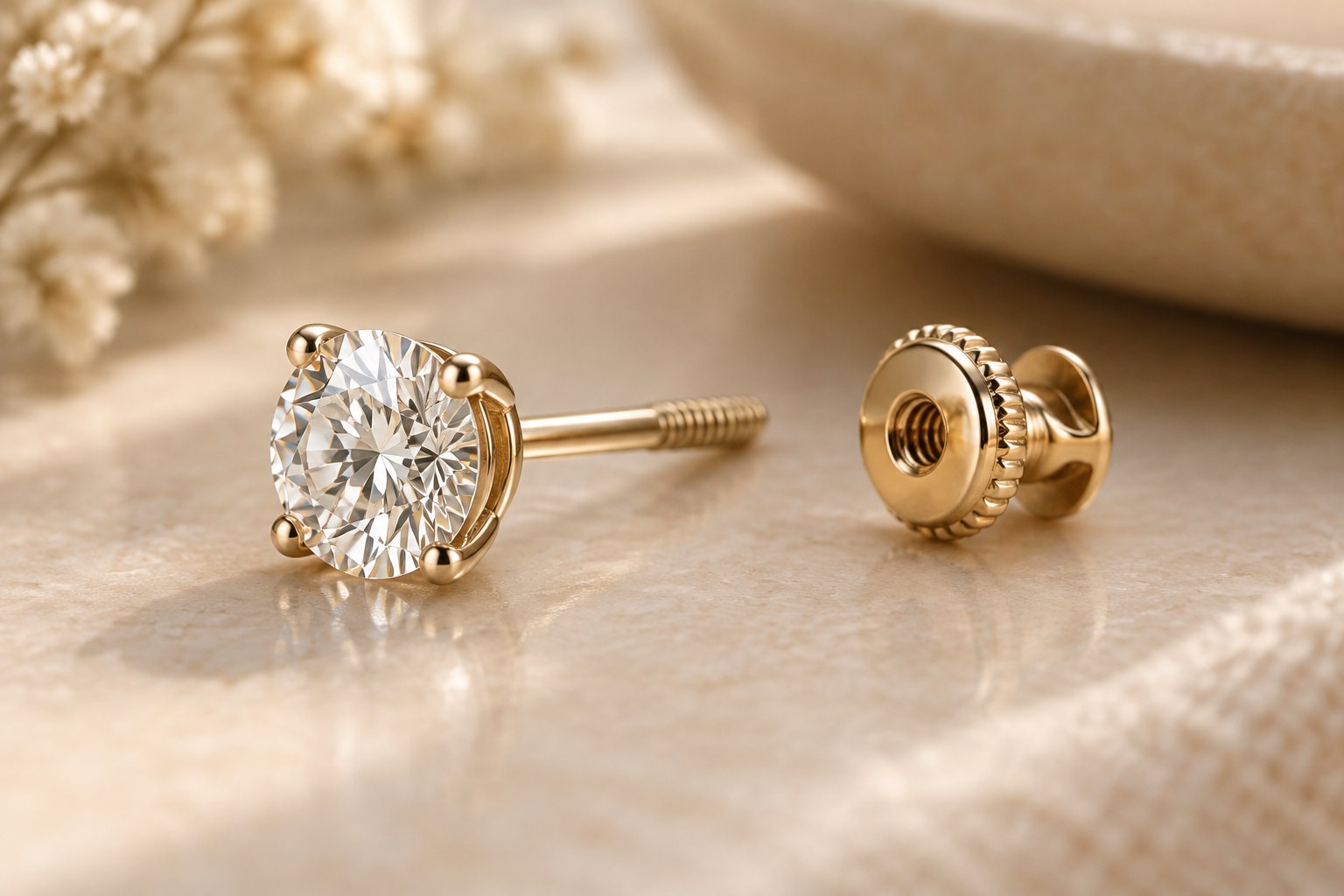
The screw back
A screw back twists onto a threaded post, so it cannot slide off - it must be unscrewed. That makes it the traditional choice for diamond studs and children's earrings. The trade-offs are time (a few seconds per ear) and the threaded post, which some find less comfortable and which collects residue that needs occasional cleaning. Screw backs on fine studs should be turned until snug, never forced; cross-threading is the main way they fail.
The flat back
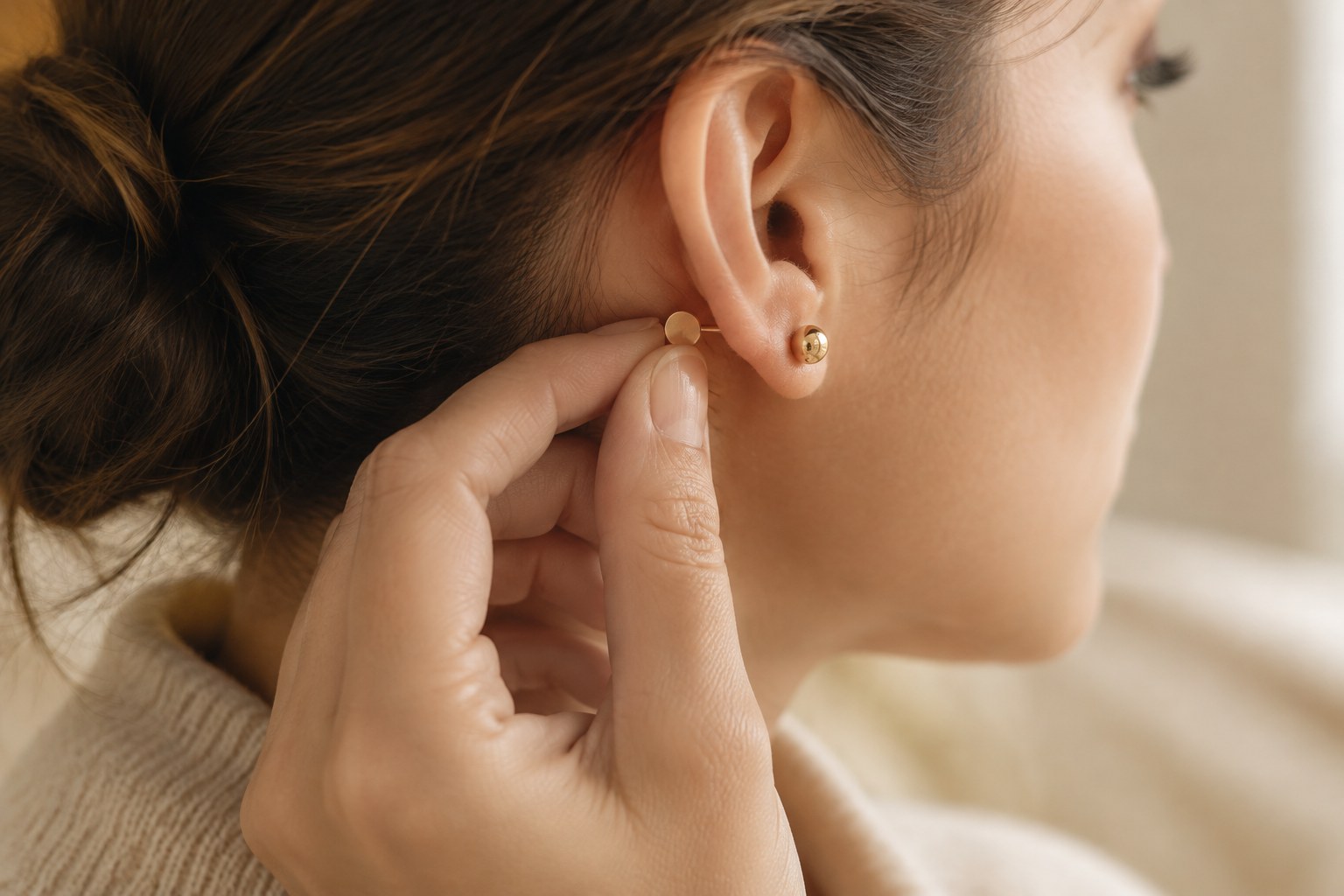
Popularised by the piercing world, flat backs - also called labret backs - have a smooth disc that sits flush behind the ear, with the decorative front either threading or pushing into a hollow post. They are the most comfortable option for sleeping and for cartilage piercings, because nothing digs in. Quality varies enormously; a well-made push-pin flat back holds firmly, while cheap versions loosen. For healed piercings and everyday studs, they are the comfort gold standard.
AI-generated illustration; not a Shewah product or a scale measurement.
SHEWAH Editorial Concept Illustration (Non-Catalogue)
The latch back and lever back
Hoops and drops use hinged mechanisms. A latch back - common on huggies and hinged hoops - clicks the post into a catch on the opposite side; the click is your confirmation. A lever back, used on drop earrings, closes a hinged wire behind the earlobe and is one of the most secure closures made, which is why so many fine diamond drops use it. If a latch stops clicking crisply, a jeweller can adjust the tension in minutes.
The omega back
Named for its shape, the omega back is a hinged loop that folds up against the earlobe and is usually paired with a post. It distributes the weight of larger earrings - clips, bold domes, statement drops - so they sit upright instead of tipping forward. You will find it on heavier fashion and fine pieces where a simple post would droop.
Rubber and silicone backs
Clear silicone backs, often shaped like tiny bullets or discs, come with many fashion earrings. They grip well at first but harden and yellow over time, so treat them as consumables and replace them regularly. A silicone disc added behind a butterfly back is also a clever trick for supporting heavier studs.
Match the back to the earring
A few pairings rarely fail: butterfly backs for small everyday studs, screw backs for valuable diamond studs, flat backs for cartilage and overnight wear, lever backs for drops, omega backs for statement pieces. And whatever the closure, the rule that saves earrings is boring but true - touch the back once when you put it on, and once when you take your coat off.
Secure sparkle, with Shewah
Shewah's lab-grown diamond studs are made with secure, comfortable fittings chosen for daily wear. If you are unsure which back suits your ears or your routine, explore Shewah's jewellery or message us on WhatsApp at +91 96622 66360 for a straightforward recommendation.
AI-generated illustration; not a Shewah product or a scale measurement.
SHEWAH Editorial Concept Illustration (Non-Catalogue)
Sources
The Maison Shewah Atelier Standard
Every creation referenced across our journal essays is made individually to order using solid 18K gold and independently certified diamonds (IGI & GIA). We uphold complete material transparency and zero synthetic plating.
Research & Gemological References
- [1]Types of Earring Backs: A Complete Guide — Jeweliste (Verified: 2026-10-28)
- [2]Earring Back Types: A Guide to Every Type — rhokea (Verified: 2026-10-28)
- [3]Flat Back vs Butterfly vs Screw Back Earrings — LYANG & CO. (Verified: 2026-10-28)


