Types of Bracelets: A Complete Guide
“From the ancient bangle to the modern bolo slider, every bracelet type explained, with fit advice and the simple formula for stacking them well.”

AI-generated illustration; not a Shewah product or a scale measurement.
SHEWAH Editorial Concept Illustration (Non-Catalogue)
Bracelets are the most quietly varied category in jewellery. Rings get the proposals and necklaces get the drama, but the wrist is where personal style shows up daily. Knowing the main types makes shopping faster and stacking far more intentional.
Bangle
The bangle is the oldest form: a stiff, closed ring of metal that slips over the hand. Bangles come in every width, plain, textured or gem-set, and they are designed to be stacked as a set, sliding loosely up and down the arm. Their rigidity is their character; a bangle keeps its shape and its line.
Cuff
A cuff wraps the whole wrist but stays open at the back, so it slides on sideways and needs no clasp. That opening makes cuffs easy to wear and lets designers go bold at the ends, often with two stones or finials bookending the wrist. A pinch bracelet is the cuff's adjustable relative, with a wider opening you squeeze for the perfect fit.
Chain
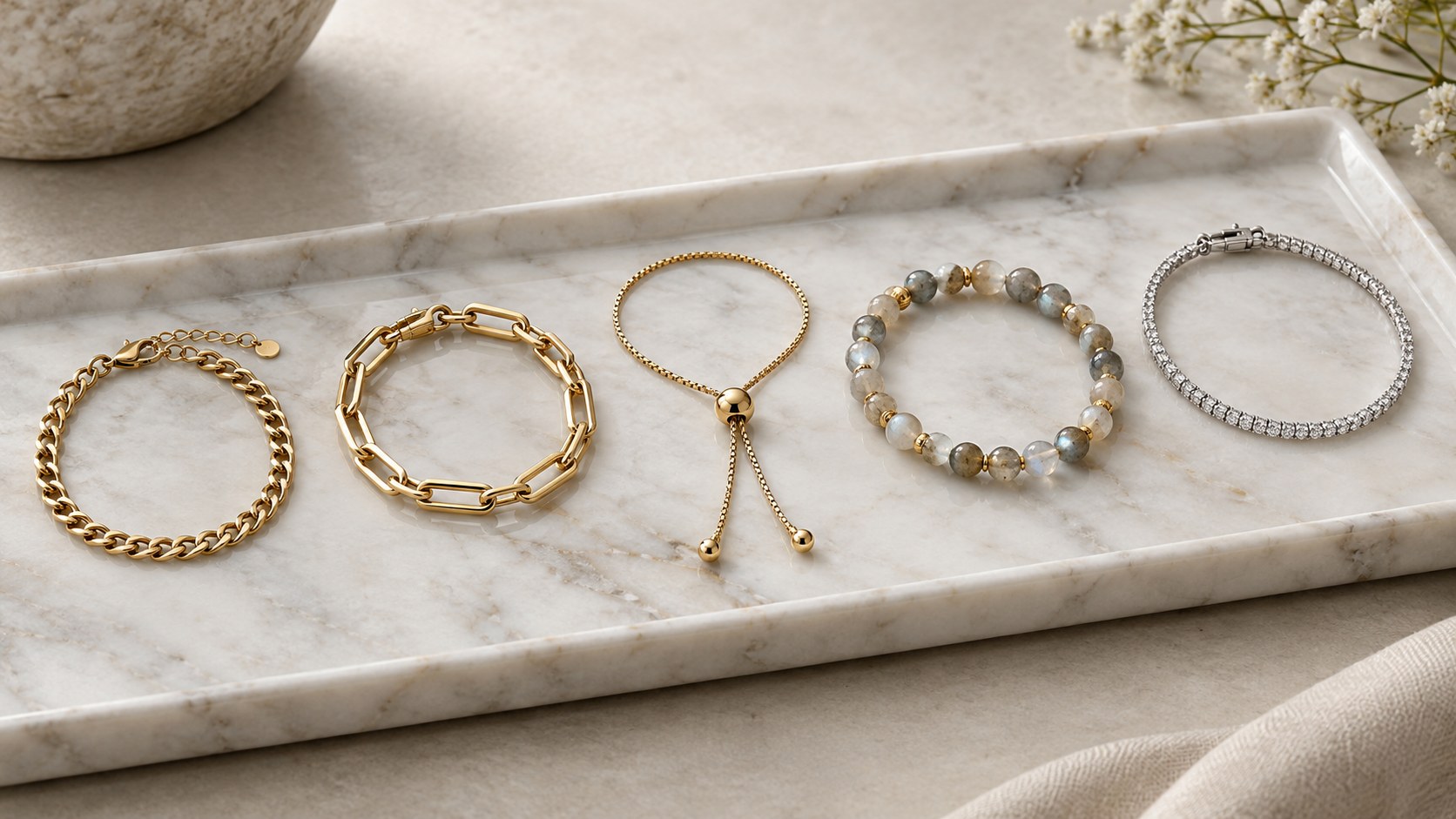
Chain bracelets are the most versatile base. Common weaves include box, curb, figaro, rope, cable and wheat, each with its own texture and drape. Worn alone, a chain bracelet is minimal; with a charm or two attached, it becomes something else entirely. Most fasten with a lobster clasp.
AI-generated illustration; not a Shewah product or a scale measurement.
SHEWAH Editorial Concept Illustration (Non-Catalogue)
Bolo and adjustable
The bolo, or slider, bracelet threads its chain through an adjustable clasp, so one size fits nearly any wrist. That makes it the safest gift in the category and the easiest piece to layer, since you can set exactly where it sits against the rest of a stack.
Link
Link bracelets are built from distinct, often larger, connected elements rather than fine chain. They range from delicate to heavy statement pieces and read a touch more structured than a simple chain.
Tennis
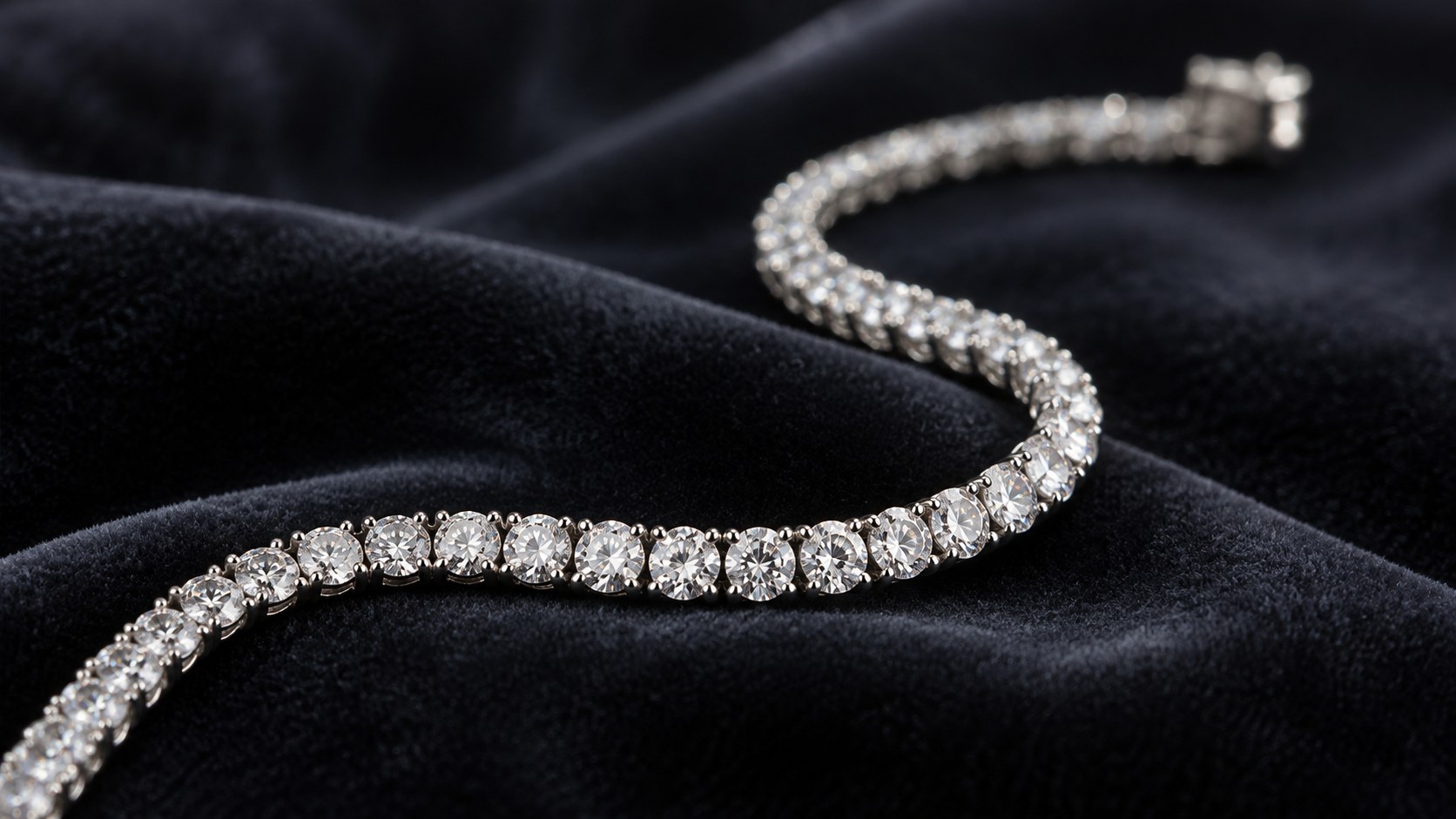
The tennis bracelet is a continuous, flexible line of individually set diamonds or gemstones. It began life as the in-line diamond bracelet and picked up its current name after a professional tennis player's diamond bracelet broke mid-match at the US Open and she asked to stop play to find it. It remains the dressiest bracelet most people will ever own, and with lab-grown diamonds, a full line of stones is more attainable than it has ever been.
Charm and beaded
Charm bracelets hang small symbolic pieces from a chain, building a wearable diary over years. Beaded bracelets string gemstones or pearls for colour and texture at the friendliest price point in the category.
How to combine them
The reliable formula is one anchor piece plus contrast: a tennis bracelet beside a plain bangle, a cuff against a fine chain, smooth against textured. Mix metals freely. Keep one bracelet the clear lead and let the rest support it, and stop before the stack clinks like wind chimes.
Getting the fit right
Fit is what separates a bracelet you wear from one that lives in a box. Measure your wrist with a strip of paper, then think about drape: chain and tennis bracelets should move a finger's width, cuffs should grip lightly, and bangles must be big enough to pass over the widest part of your hand but not so big they slide to your elbow. Adjustable bolo styles sidestep the whole question, which is why they make such dependable gifts.
Worth saying plainly: bracelets take more knocks than any other jewellery you own, because your hands lead every day. Save your most delicate pieces for occasions and let sturdy chains, bangles and cuffs carry the everyday shifts.
Your wrist, your way with Shewah
Tell us the combination you are picturing and we will make the pieces to order, quoted in full before work begins.
Explore Shewah's jewellery or contact us on WhatsApp at +91 96622 66360 to talk bracelets.
AI-generated illustration; not a Shewah product or a scale measurement.
SHEWAH Editorial Concept Illustration (Non-Catalogue)
Sources
- Our Guide to Bracelets - Kendra Scott
- Bracelet & Anklet Basics - Kay
The Maison Shewah Atelier Standard
Every creation referenced across our journal essays is made individually to order using solid 18K gold and independently certified diamonds (IGI & GIA). We uphold complete material transparency and zero synthetic plating.
Research & Gemological References
- [1]Our Guide to Bracelets — Kendra Scott (Verified: 2026-10-18)
- [2]Bracelet & Anklet Basics — Kay (Verified: 2026-10-18)


