Pavé Settings Explained: What They Are and How to Choose Them
“The setting that makes metal vanish and light take over - what pavé is, the variations you will meet, and the buying checks that matter.”
AI-generated illustration; not a Shewah product or a scale measurement.
SHEWAH Editorial Concept Illustration (Non-Catalogue)
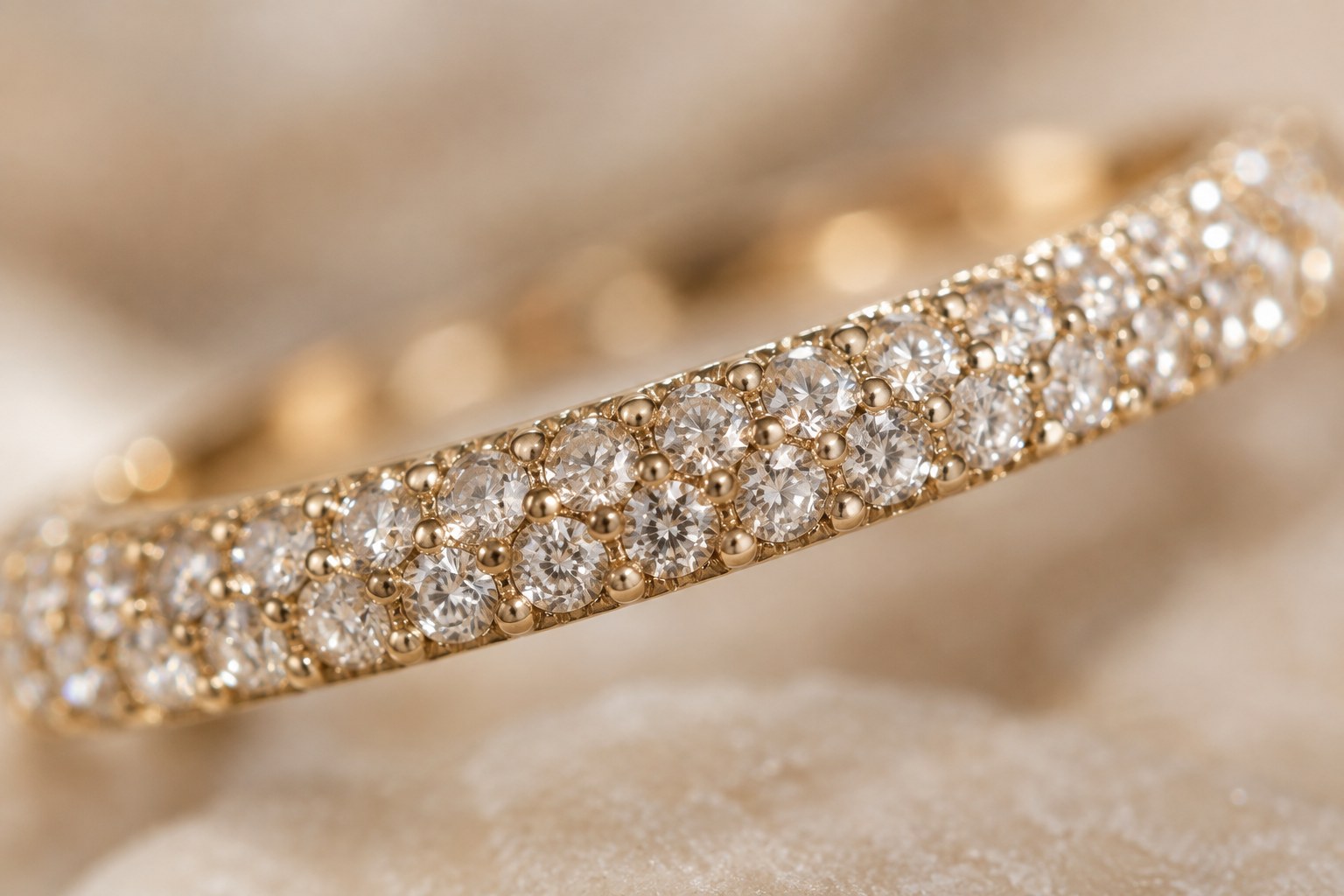
Few setting styles deliver as much sparkle per millimetre as pavé - the technique that coats metal in a continuous carpet of small diamonds. The word comes from the French for "paved", and the image is exact: a surface of stones set edge to edge, like a glittering cobbled street. Here is what it is, how it is made, and what to check before you buy.
What pavé actually is
In a pavé setting, many small diamonds - usually melee, the trade term for stones under about 0.2 carats - are drilled into the metal and held by tiny beads or claws raised from the surrounding surface. The metal nearly disappears, leaving an unbroken field of light. GIA's 4Cs guide notes that melee diamonds, despite their size, are cut with the same faceting and care as their larger cousins, which is why a good pavé surface shimmers rather than merely glitters.
The variations you will meet
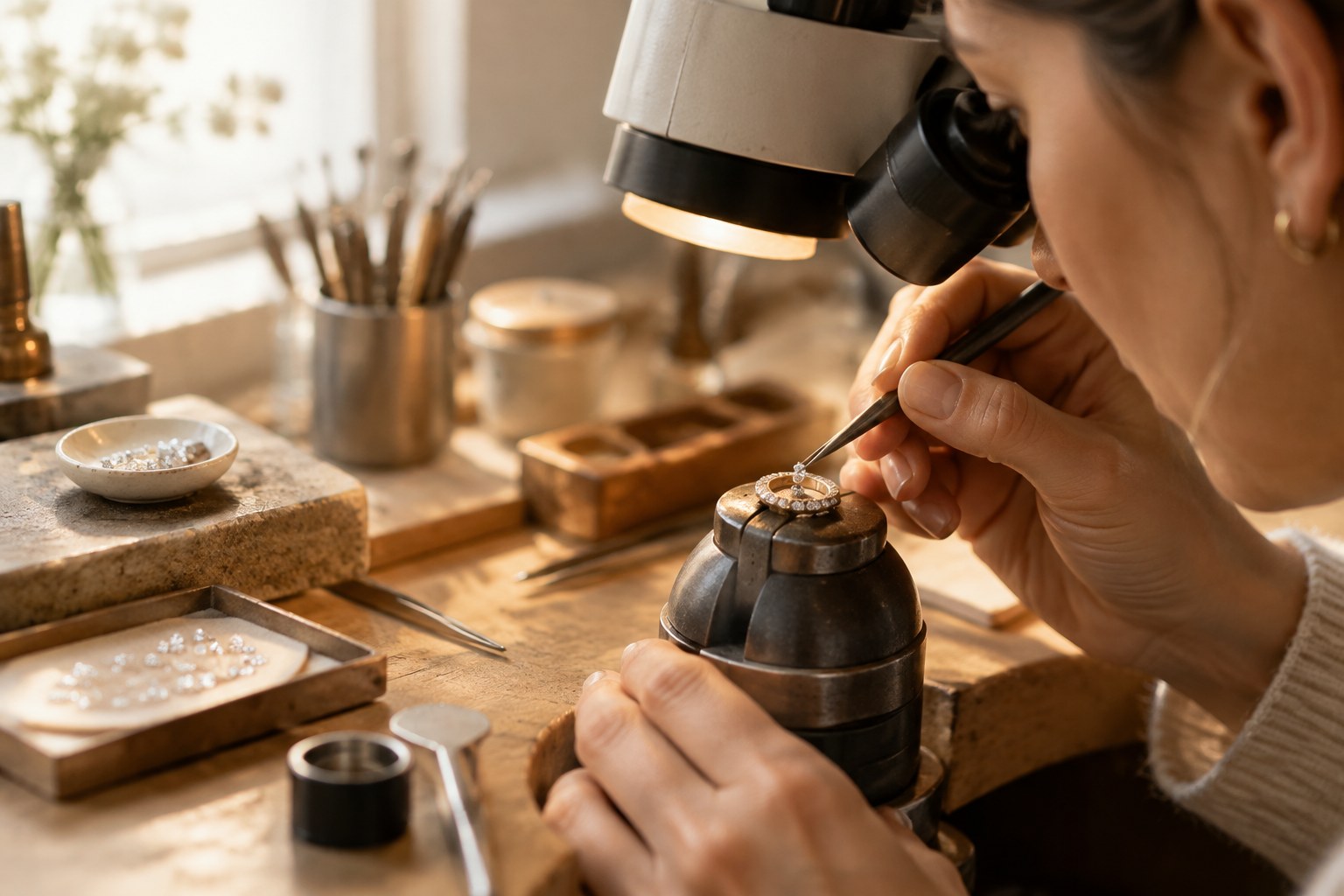
Classic pavé uses visible small beads over each stone's edge. Micro-pavé shrinks everything - smaller stones, finer beads, under magnification at the bench - for an even smoother, more fabric-like surface. French pavé cuts a small V beneath each stone to admit more light. You will also hear "bead set" and "bright cut" used for close relatives. The family resemblance matters more than the terminology: all of them aim to make metal vanish and light take over.
Pavé versus its neighbours
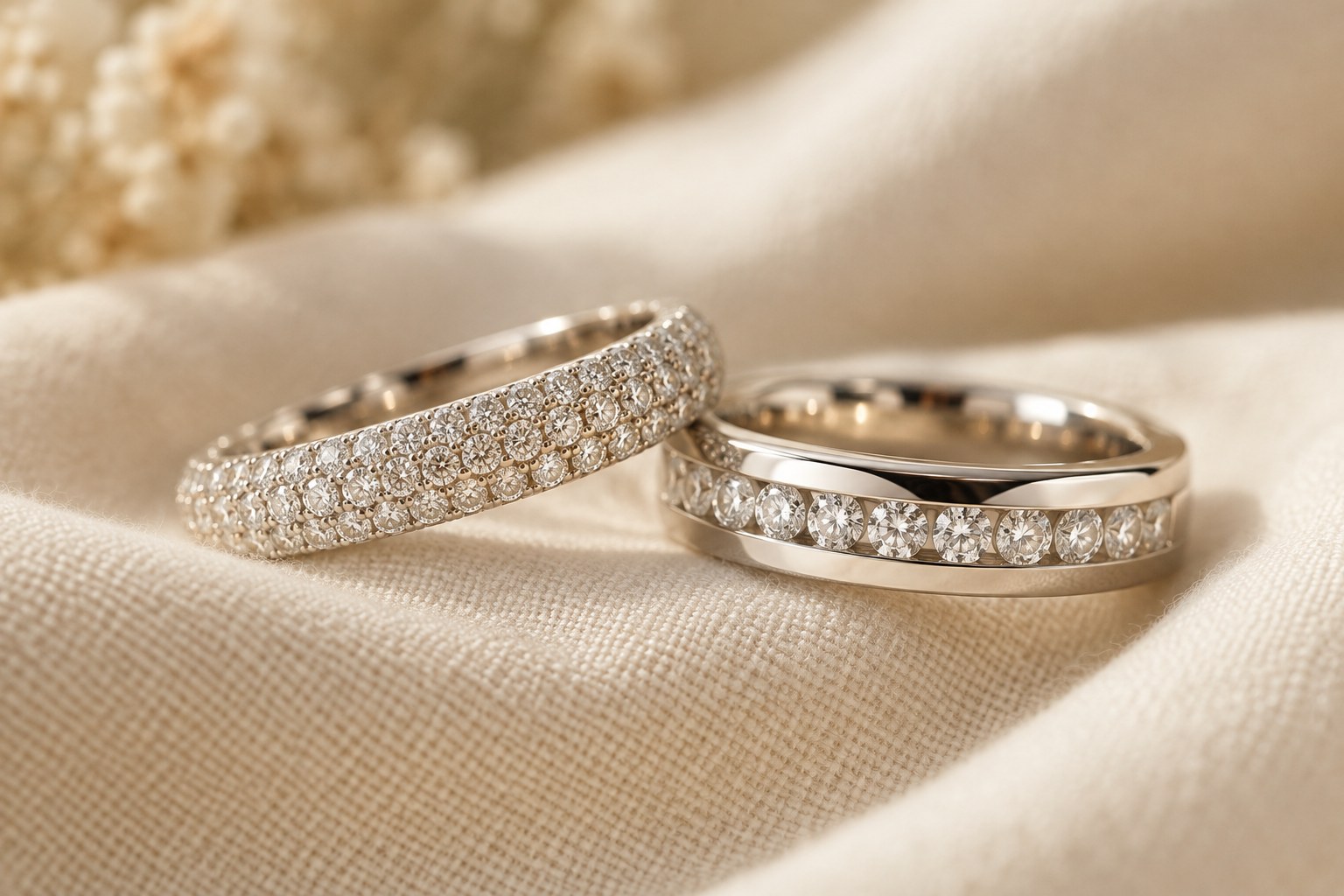
Pavé is often confused with channel setting, where stones sit in a groove between two metal rails - smoother to the touch, more protected, slightly less brilliant. Shared-prong settings hold each stone with claws common to its neighbours, a structure between pavé and classic claw work. And a plain polished band, of course, is the quiet opposite. Choosing among them is choosing how much light and how much metal you want to see.
AI-generated illustration; not a Shewah product or a scale measurement.
SHEWAH Editorial Concept Illustration (Non-Catalogue)
Where pavé shines brightest
Engagement ring shoulders are the classic home, where pavé draws the eye up to the centre stone. Full and half eternity bands use it for continuous sparkle. Halos lean on pavé to make a centre stone look larger. And it appears far beyond rings: pavé hoops, pendants, bangles and watch bezels all borrow the same magic.
What to check when buying
Run a fingertip gently over the surface - quality pavé feels even, with no snagging beads. Look along the line in good light: the stones should sit level, matched in colour and size, with beads that are neat and symmetrical. Ask who made it and how the stones are secured; well-executed pavé is secure for daily wear, while rushed work sheds stones. Lab-grown diamonds suit pavé beautifully, since matched melee in quantity becomes genuinely attainable.
Living with pavé
Thousands of tiny edges mean pavé appreciates kindness. Take pavé rings off for the gym, gardening and heavy housework; knocks are the enemy of small beads. Clean gently with warm water, mild soap and a soft brush - and if you use an ultrasonic cleaner, have a jeweller confirm the setting's condition first. A yearly professional check of the beads keeps every stone exactly where it belongs.
Discover pavé done properly with Shewah
Shewah's pavé pieces are set stone by stone in certified lab-grown diamonds by Surat's master craftspeople. Explore Shewah's jewellery, or message us on WhatsApp at +91 96622 66360 to see the work up close.
AI-generated illustration; not a Shewah product or a scale measurement.
SHEWAH Editorial Concept Illustration (Non-Catalogue)
Sources
- Diamond settings explained: the pavé ring setting - BAUNAT
- What Is A Pave Diamond? - Brilliance
- Melee Diamonds: Tiny Diamonds, Big Impact - GIA 4Cs
- Ring Setting Styles - Prong, Bezel, Channel & More - MOH London
The Maison Shewah Atelier Standard
Every creation referenced across our journal essays is made individually to order using solid 18K gold and independently certified diamonds (IGI & GIA). We uphold complete material transparency and zero synthetic plating.
Research & Gemological References
- [1]Diamond settings explained: the pavé ring setting — BAUNAT (Verified: 2026-10-26)
- [2]What Is A Pave Diamond? — Brilliance (Verified: 2026-10-26)
- [3]Melee Diamonds: Tiny Diamonds, Big Impact — GIA 4Cs (Verified: 2026-10-26)
- [4]Ring Setting Styles - Prong, Bezel, Channel & More — MOH London (Verified: 2026-10-26)


