Opal Meaning and Properties: October's Birthstone
“Opal flashes every colour of the rainbow from grids of silica spheres a fraction of a micron wide. Here is what October's birthstone means, how it forms, and how to wear it well.”

AI-generated illustration; not a Shewah product or a scale measurement.
SHEWAH Editorial Concept Illustration (Non-Catalogue)
Few gems reward a second look the way opal does. Turn one under light and it flashes green, then red, then electric blue, as if a small storm were trapped inside the stone. No two opals show the same pattern, which is a large part of their pull: every opal is, in a real sense, one of one.
What opal actually is
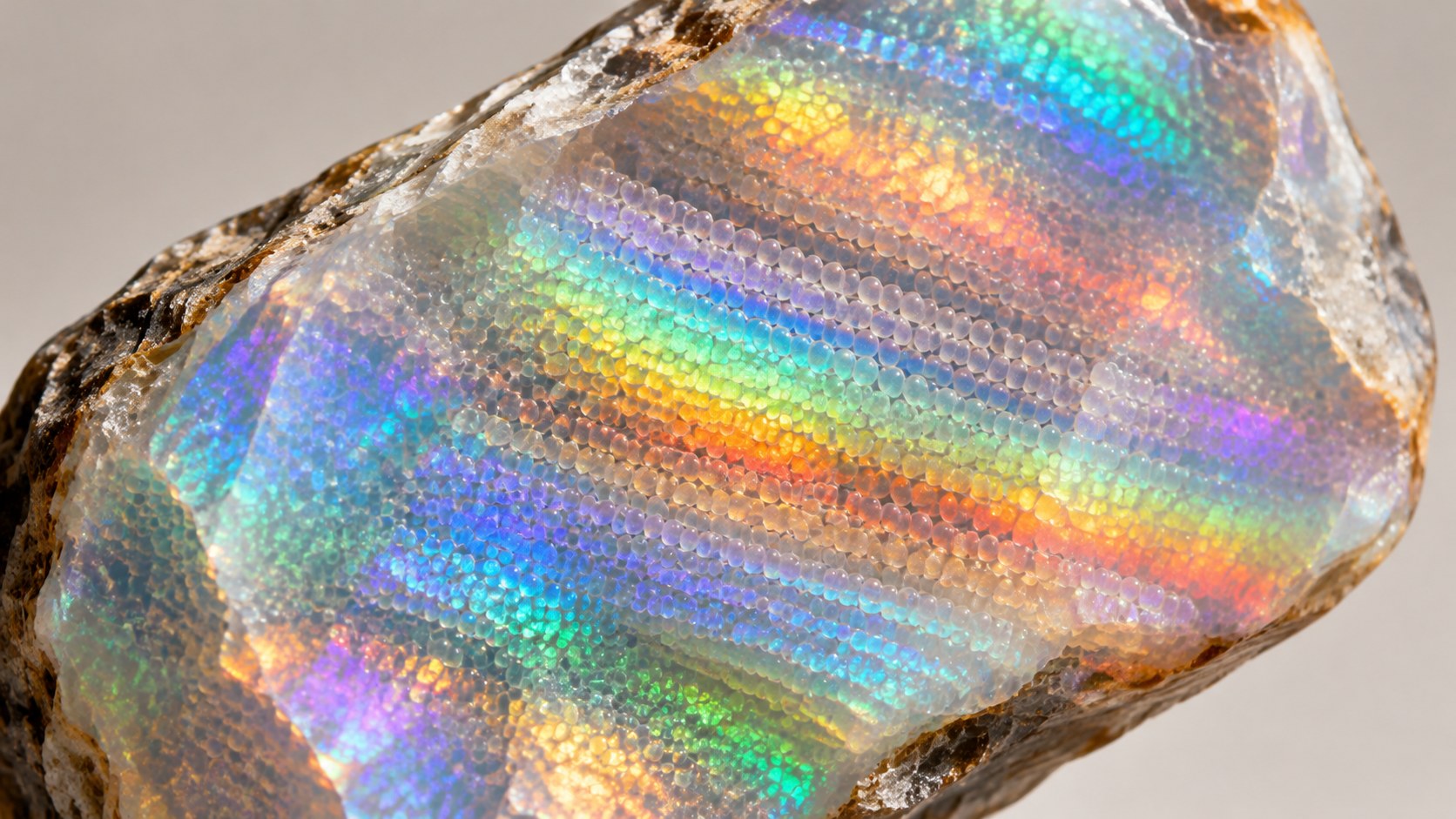
Opal is a hydrated form of silica, and its famous play-of-colour is a physical effect, not a pigment. When opal formed, silica gel filled crevices in rock; as the water evaporated, the silica was left behind as tiny spheres. Those spheres stack in grids around 0.2 microns in size, and light diffracting through the stacked grids splits into flashes of spectral colour, like light through a prism. Opal can still hold up to 20% water trapped within its silica structure.
On the Mohs scale opal sits at 5 to 6.5, noticeably softer than sapphire or diamond. That single fact shapes how it should be worn, and we will come back to it.
Meaning and lore
Because opal carries the colours of other gems, the Romans considered it the most precious and powerful stone of all. Bedouin tradition held that opals contained lightning and fell from the sky during thunderstorms. It is the birthstone for October, and for many wearers that shifting fire reads as a symbol of creativity and spontaneity rather than any single fixed meaning.
Where opal comes from
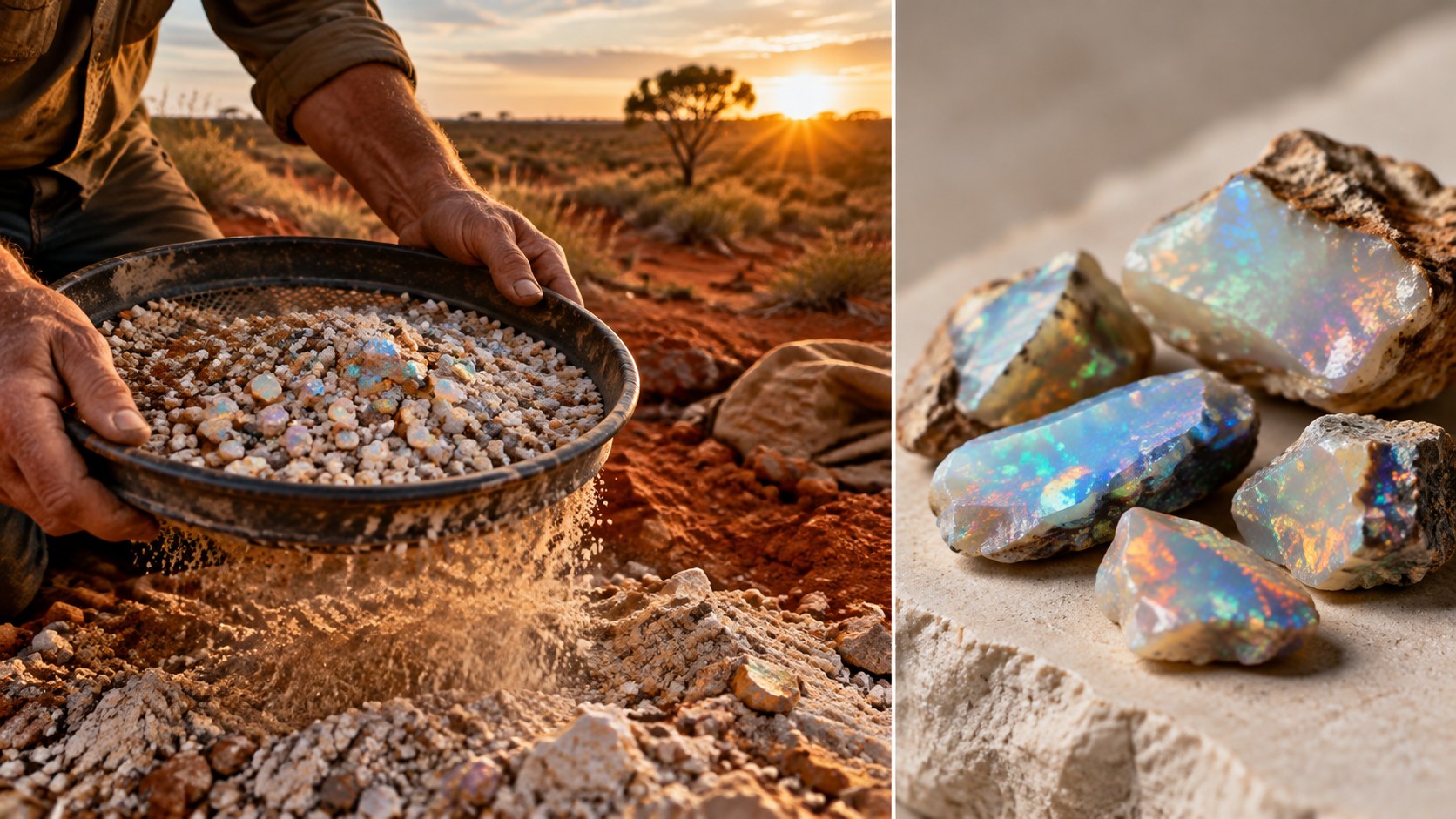
Australia's mines began producing opals commercially in the 1890s, and the country quickly became, and remains, the world's primary source. If you picture an opal field, picture the Australian outback.
AI-generated illustration; not a Shewah product or a scale measurement.
SHEWAH Editorial Concept Illustration (Non-Catalogue)
How opal is judged
With most gems the conversation starts with colour and clarity. With opal it starts with the play-of-colour itself: how broad the flashes are, how intense, and what pattern they form across the face of the stone. Cutters often shape fine opals into irregular outlines rather than strict ovals or cushions, keeping as much of the best play-of-colour as possible instead of sacrificing it to symmetry.
Wearing opal well
At Mohs 5 to 6.5, opal asks for a little thought. In earrings and pendants it lives a sheltered life and can be worn constantly. In a ring, look for settings that protect the edges, and take the ring off for the gym, the garden and the washing up. Kept away from harder stones in the jewellery box, an opal will hold its fire for generations. The trade-off is simple: no other gem gives you this effect, and this effect asks for a little care.
How to choose one
Judge an opal the way you would judge a sunset, not the way you would judge a diamond. Breadth of colour first: stones that flash across the whole spectrum command the most attention. Then intensity, because colour that shows in soft indoor light, not only under a jeweller's spot, is colour you will actually enjoy. Then pattern, which is pure personal taste; broad rolling flashes, fine pinfire, and bold harlequin patches are all collected, and none is objectively correct. Finally, trust your eyes over any description. Because no two opals match, the right stone is the specific stone you cannot stop looking at, and a photograph never quite does it justice.
Colour and character with Shewah
If you love opal's fire but want the everyday durability of lab-grown diamond around it, we can build the piece you are picturing and quote it in full before any work begins.
Explore Shewah's jewellery or contact us on WhatsApp at +91 96622 66360 to talk stones.
AI-generated illustration; not a Shewah product or a scale measurement.
SHEWAH Editorial Concept Illustration (Non-Catalogue)
Sources
- Opal Gemstone - GIA
The Maison Shewah Atelier Standard
Every creation referenced across our journal essays is made individually to order using solid 18K gold and independently certified diamonds (IGI & GIA). We uphold complete material transparency and zero synthetic plating.
Research & Gemological References
- [1]Opal Gemstone — GIA (Verified: 2026-10-18)


