How to Choose a Lab-Grown Diamond Tennis Bracelet
“Total carat weight, settings, fit, clasps and certification: how to choose a lab-grown diamond tennis bracelet that lasts decades.”
AI-generated illustration; not a Shewah product or a scale measurement.
SHEWAH Editorial Concept Illustration (Non-Catalogue)
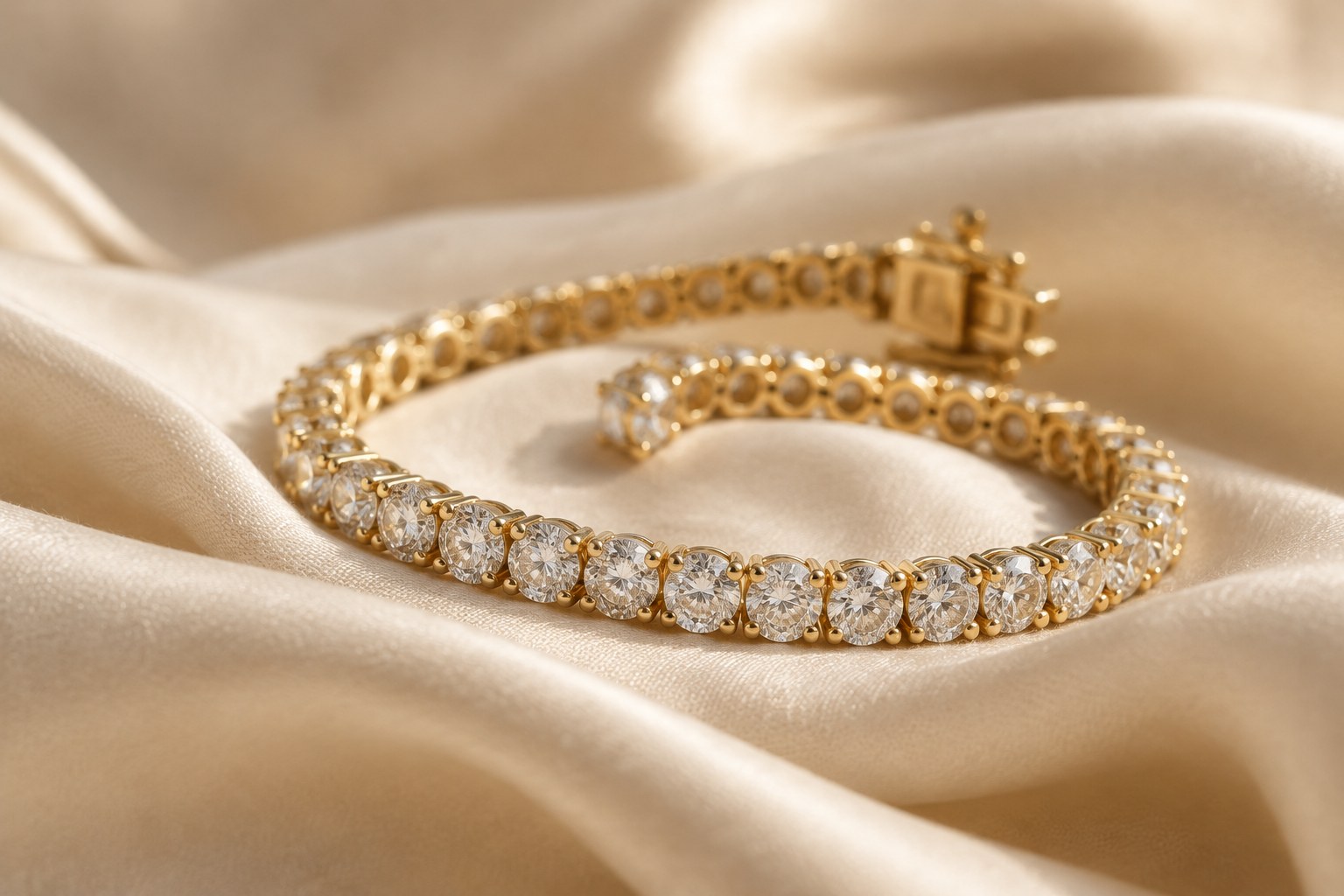
Few pieces carry the easy glamour of a tennis bracelet: an unbroken line of diamonds that moves with the wrist and catches light with every gesture. Once an occasional indulgence, the style has become an everyday signature - and lab-grown diamonds are the reason, putting a full circle of certified brilliance within reach. Here is what matters when you choose one.
What makes it a tennis bracelet
The defining features are a flexible line of individually set diamonds, matched for size and quality, joined by discreet links and closed with a secure clasp. The name, famously, comes from the 1987 US Open, when Chris Evert's diamond bracelet came loose mid-match and play stopped while she looked for it. The style was decades old by then, but the story gave it a name - and a permanent association with sporty, unstudied elegance.
Carat weight: think total, not per stone
Tennis bracelets are described by total carat weight across every stone. Around three carats total is slender and everyday; five to seven carats is the classic, visible-from-across-the-table presence; ten carats and beyond is unapologetic evening jewellery. The diamonds themselves are small - a seven-carat bracelet might hold fifty-odd stones - so matching matters more than any individual diamond. Lab-grown makes each step up the ladder dramatically more attainable.
Settings: prong, bezel and channel
A four-prong basket is the classic: maximum light, the most traditional look. Three-prong martini settings pull the stones closer together for a sleeker line. Bezels wrap each diamond in metal - the smoothest, most snag-proof option, with a modern feel and slightly protected sparkle. Channel settings rail the stones between two metal tracks: secure and sleek, though the diamonds sit deeper. Active wearers should look hard at bezels and channels; sparkle maximalists at prongs.
AI-generated illustration; not a Shewah product or a scale measurement.
SHEWAH Editorial Concept Illustration (Non-Catalogue)
Length and fit
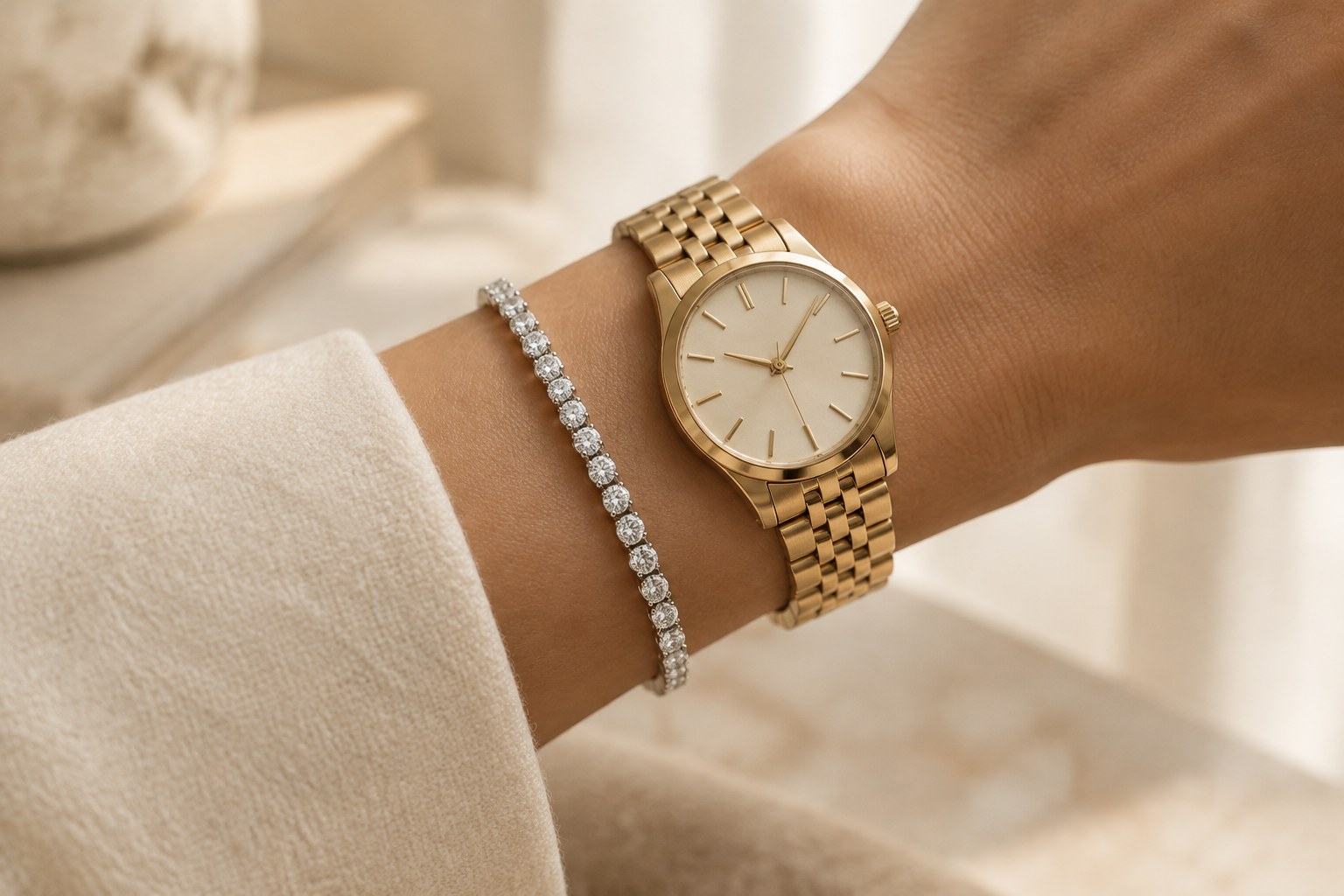
Most tennis bracelets are 6.5 to 7.5 inches. The right fit closes around the wrist with a finger's width of ease: snug enough not to rotate, loose enough to move freely. Measure your wrist snugly and add one to one and a half centimetres. A bracelet that spins will wear its links unevenly; one that bites will live in its box.
Clasp and safety
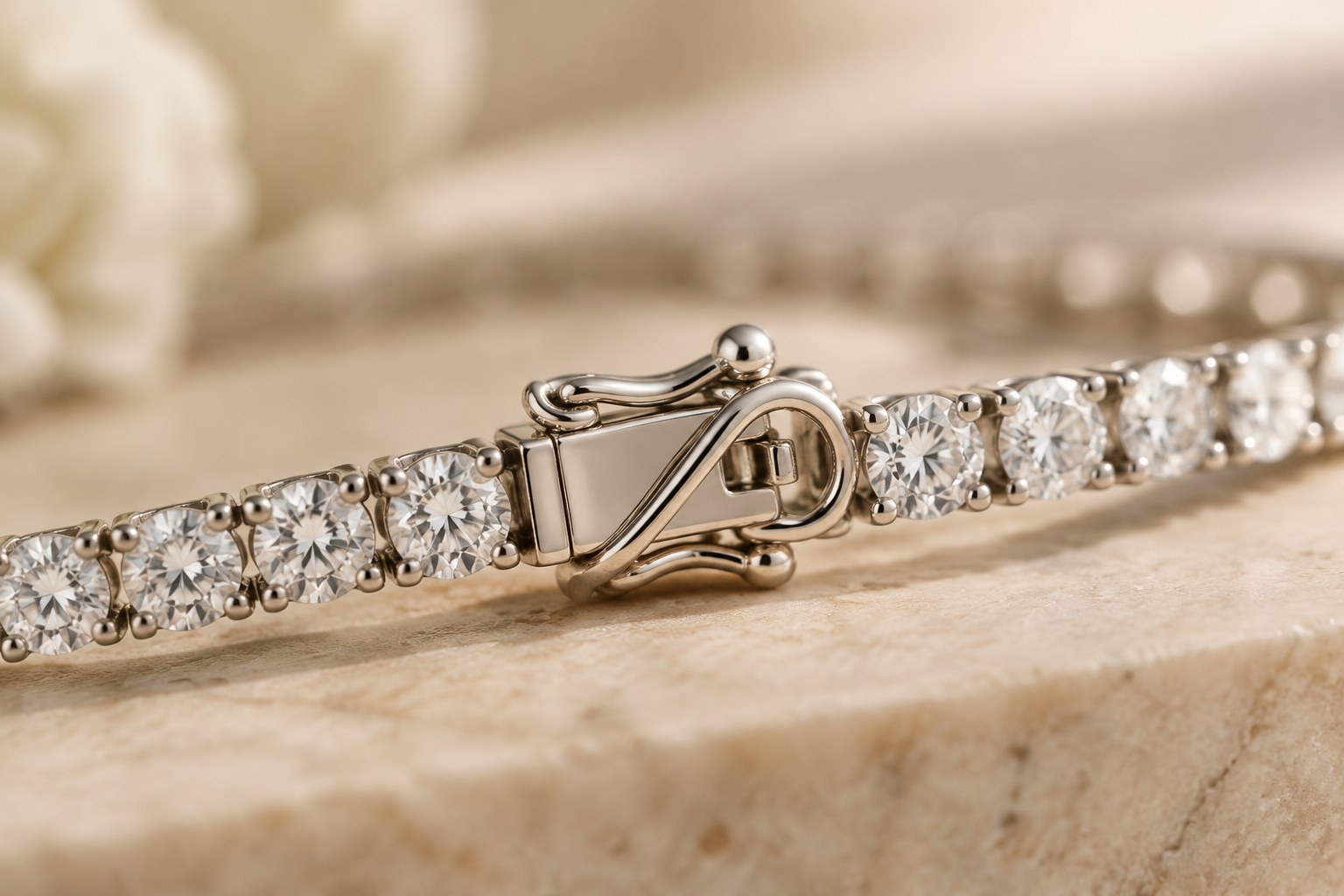
This is the bracelet's one vulnerability, and it deserves your attention. Look for a box clasp with a figure-eight safety catch - the little hinged arm that folds over the clasp as a second lock. That combination is the standard for a reason. Give the clasp a firm tug when you first receive the bracelet, and have the safety catch checked whenever the piece is cleaned.
Diamonds and certification
Because the stones are small and numerous, what you are buying is consistency: every diamond matched in colour and clarity so the line reads as one ribbon of light. Near-colourless grades with eye-clean clarity are the sweet spot. Reputable makers supply documentation for the piece and the stones' grading, with lab-grown diamonds certified by the same independent gemmological laboratories that grade mined stones.
Wearing it daily
The modern tennis bracelet is made for daily wear: alone with a watch, stacked with a slim bangle, dressed up or down. Take it off for the gym, the sea and heavy lifting - diamonds are hard but the links between them are fine engineering. Clean it in warm soapy water with a soft brush, and the line stays bright for decades.
Find your line with Shewah
Shewah's lab-grown diamond tennis bracelets are made to order in your choice of setting, length and total weight, with certified stones throughout. Explore Shewah's jewellery or message us on WhatsApp at +91 96622 66360 to talk through the options.
AI-generated illustration; not a Shewah product or a scale measurement.
SHEWAH Editorial Concept Illustration (Non-Catalogue)
Sources
The Maison Shewah Atelier Standard
Every creation referenced across our journal essays is made individually to order using solid 18K gold and independently certified diamonds (IGI & GIA). We uphold complete material transparency and zero synthetic plating.
Research & Gemological References
- [1]Lab-Grown Diamond Tennis Bracelets: Everything to Know — Diamonds Pro (Verified: 2026-10-28)
- [2]Buying Guide: Lab-Grown Diamond Tennis Bracelets — VRAI (Verified: 2026-10-28)
- [3]A Guide to Buying Lab Grown Diamond Bracelets and Bangles — Whiteflash (Verified: 2026-10-28)


