Lab-Grown Diamond Stud Earrings: A Buying Guide
“Studs are the hardest-working earrings you can own, and lab-grown diamonds make serious sparkle attainable. How to choose the right pair, from the 4Cs to secure backs.”

AI-generated illustration; not a Shewah product or a scale measurement.
SHEWAH Editorial Concept Illustration (Non-Catalogue)
Diamond stud earrings are the quiet workhorse of a jewellery wardrobe. They dress up a t-shirt, hold their own at a wedding, and never fight with anything else you are wearing. With lab-grown diamonds they have also become one of the most attainable ways to own serious sparkle. Here is how to choose a pair well.
A short history
Ear ornaments are ancient; men and women have worn them for five millennia, and an early form of the stud was popular in ancient Egypt. Modern diamond studs appeared in the latter part of the 19th century, surged in the 1970s, and have been a staple ever since, worn by everyone from athletes to the Duchess of Sussex, who chose diamond studs for her wedding in 2018.
The 4Cs, adjusted for ears
The 4Cs still govern quality, but earrings get graded by different eyes than engagement rings. Nobody examines your earlobes at arm's length.
Colour: diamonds are tiny mirrors, picking up tones from the metal, your skin and your hair, so paying for the top of the D-to-Z scale matters far less in a stud. Clarity: inclusions in SI or even I grades are essentially invisible on the ear, which frees up budget. Cut: this is where you should not compromise, since cut is what produces sparkle; for round brilliants, look for Excellent or Very Good cut grades. Carat: studs are sold by total weight for the pair, so a 1 carat total weight pair means two half-carat stones. Buying just under the magic sizes, 0.90ctw instead of 1.00ctw, saves real money for a difference nobody can see.
Shape, metal and setting
Round brilliant is the classic and the sparkliest; princess cut gives a crisper, more modern square. Metal colour is a styling tool: white gold or platinum flatters colourless to near-colourless stones, while yellow and rose gold harmonise warmly with lower colour grades. If you have metal sensitivities, platinum is hypoallergenic.
Settings trade sparkle for security. Three or four prongs put the least metal on the stone and show the most diamond; a bezel wraps the stone and protects it best. For backs, screw backs and locking styles such as La Pousette give the most protection against loss, which is the real risk with earrings.
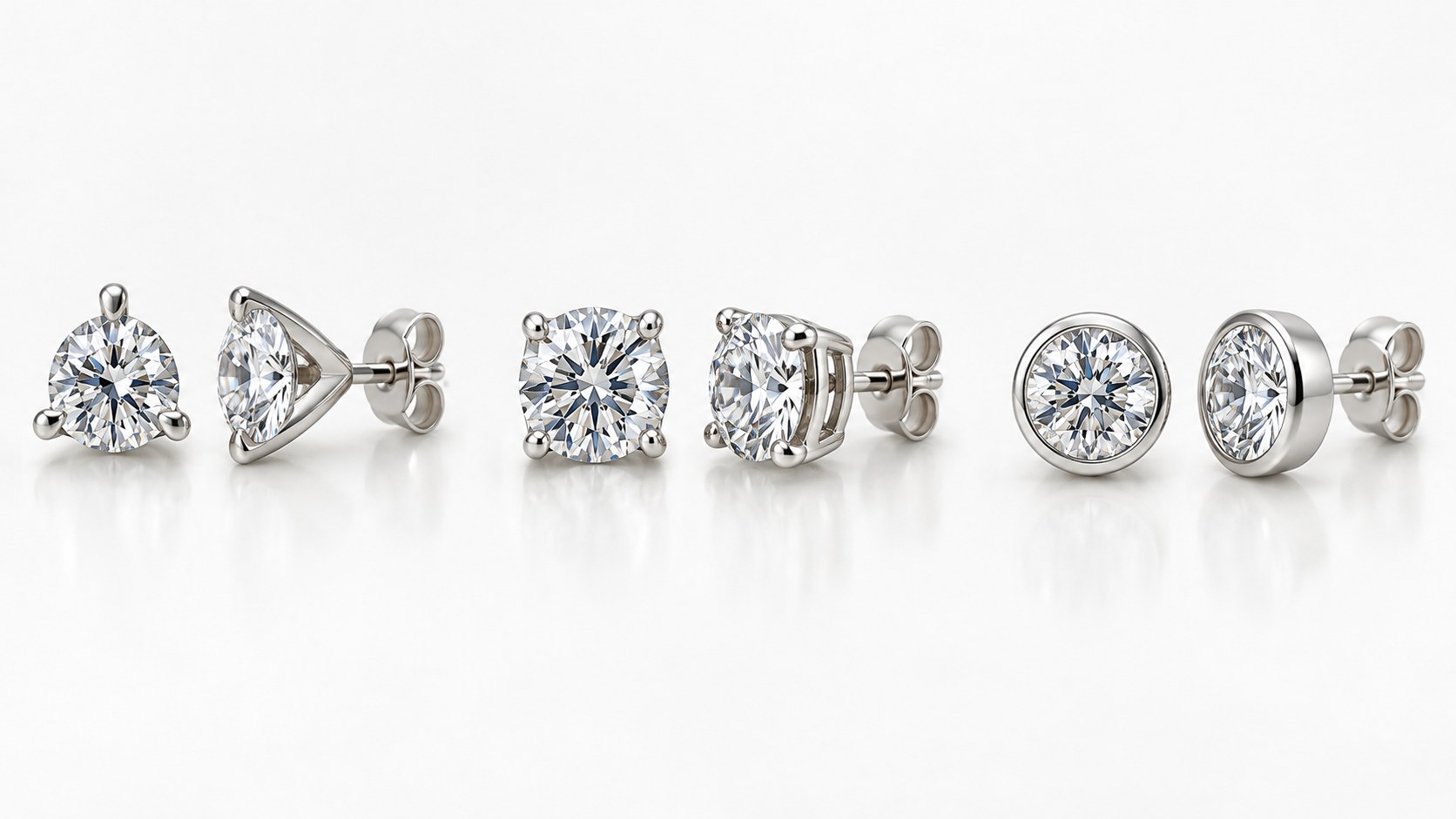
AI-generated illustration; not a Shewah product or a scale measurement.
SHEWAH Editorial Concept Illustration (Non-Catalogue)
What lab-grown changes
Lab-grown diamonds are graded on the same 4Cs, and the same buying logic applies: put your money into cut, relax on colour and clarity. The difference is what your budget buys. As a natural-diamond benchmark, the International Gem Society's picks ran from roughly $650 for a half-carat total weight pair with I colour and SI clarity to about $3,900 for 1.5 carats total weight. Lab-grown makes those same sizes dramatically more attainable.
Whichever you choose, buy certified stones. GIA issues grading reports for laboratory-grown diamonds, and IGI reports cover lab-grown stones with the full 4Cs. A report is your proof that the pair you were sold is the pair you received.
How much to spend
Set the budget first, then spend it in this order: cut quality, carat size, then colour and clarity only if money remains. That sequence buys sparkle you can see rather than paper grades you cannot.
Your everyday pair with Shewah
Tell us the size and metal you are picturing and we will make your lab-grown diamond studs to order, quoted in full before work begins.
Explore Shewah's jewellery or contact us on WhatsApp at +91 96622 66360 to talk stones.
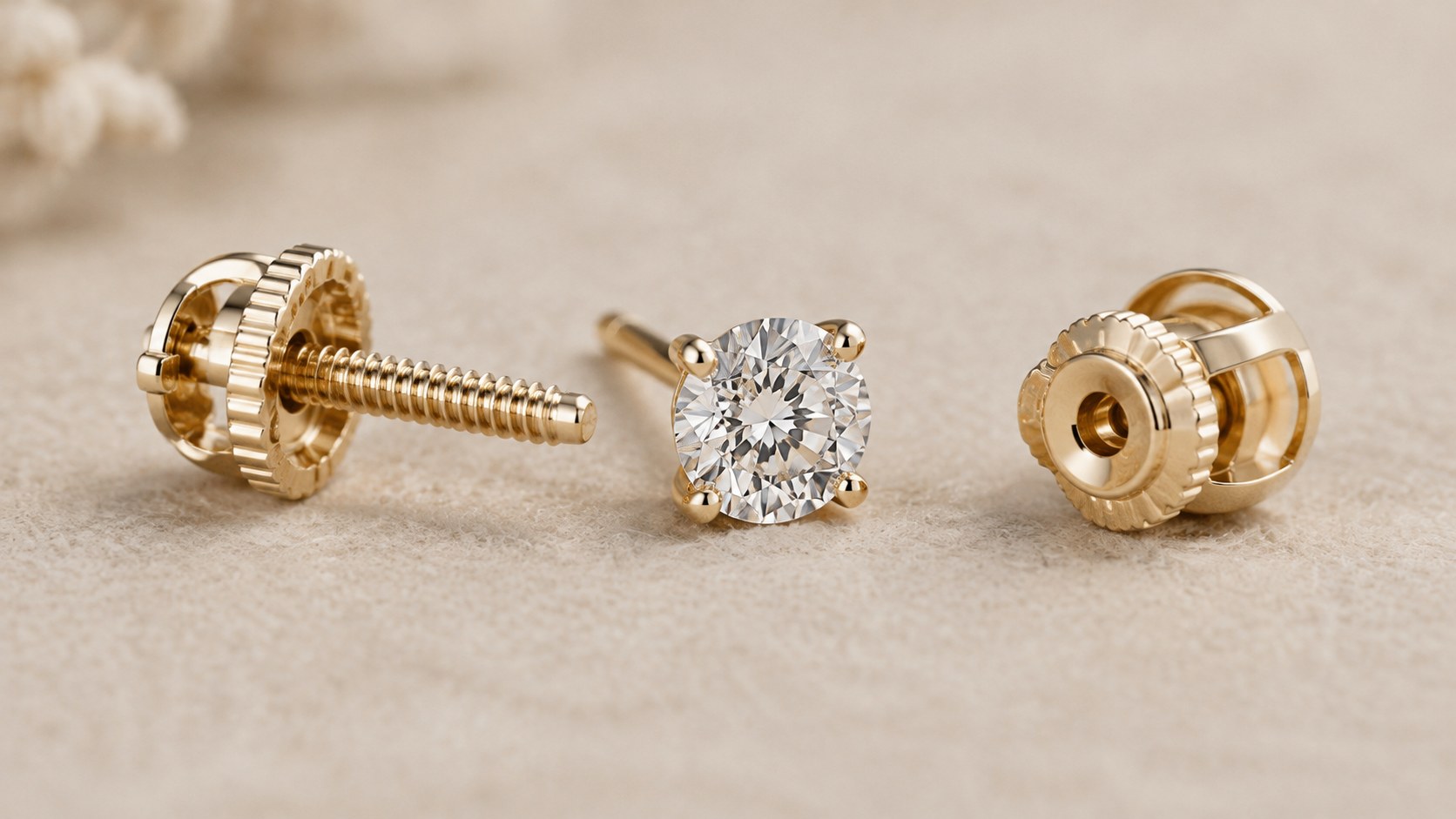
AI-generated illustration; not a Shewah product or a scale measurement.
SHEWAH Editorial Concept Illustration (Non-Catalogue)
Sources
- How to Choose Diamond Stud Earrings - GIA 4Cs
- Buying Diamond Stud Earrings - International Gem Society
- Laboratory-Grown Diamond Grading Report Service - GIA
- Lab-Grown Diamond Report - IGI
The Maison Shewah Atelier Standard
Every creation referenced across our journal essays is made individually to order using solid 18K gold and independently certified diamonds (IGI & GIA). We uphold complete material transparency and zero synthetic plating.
Research & Gemological References
- [1]How to Choose Diamond Stud Earrings — GIA 4Cs (Verified: 2026-10-18)
- [2]Buying Diamond Stud Earrings — International Gem Society (Verified: 2026-10-18)
- [3]Laboratory-Grown Diamond Grading Report Service — GIA (Verified: 2026-10-18)
- [4]Lab-Grown Diamond Report — IGI (Verified: 2026-10-18)


