How to Tell if Pearls Are Real: 6 At-Home Tests That Actually Work
“Gritty or smooth? From the tooth test to the drill-hole check, here is how to tell genuine pearls from convincing imitations before you buy.”
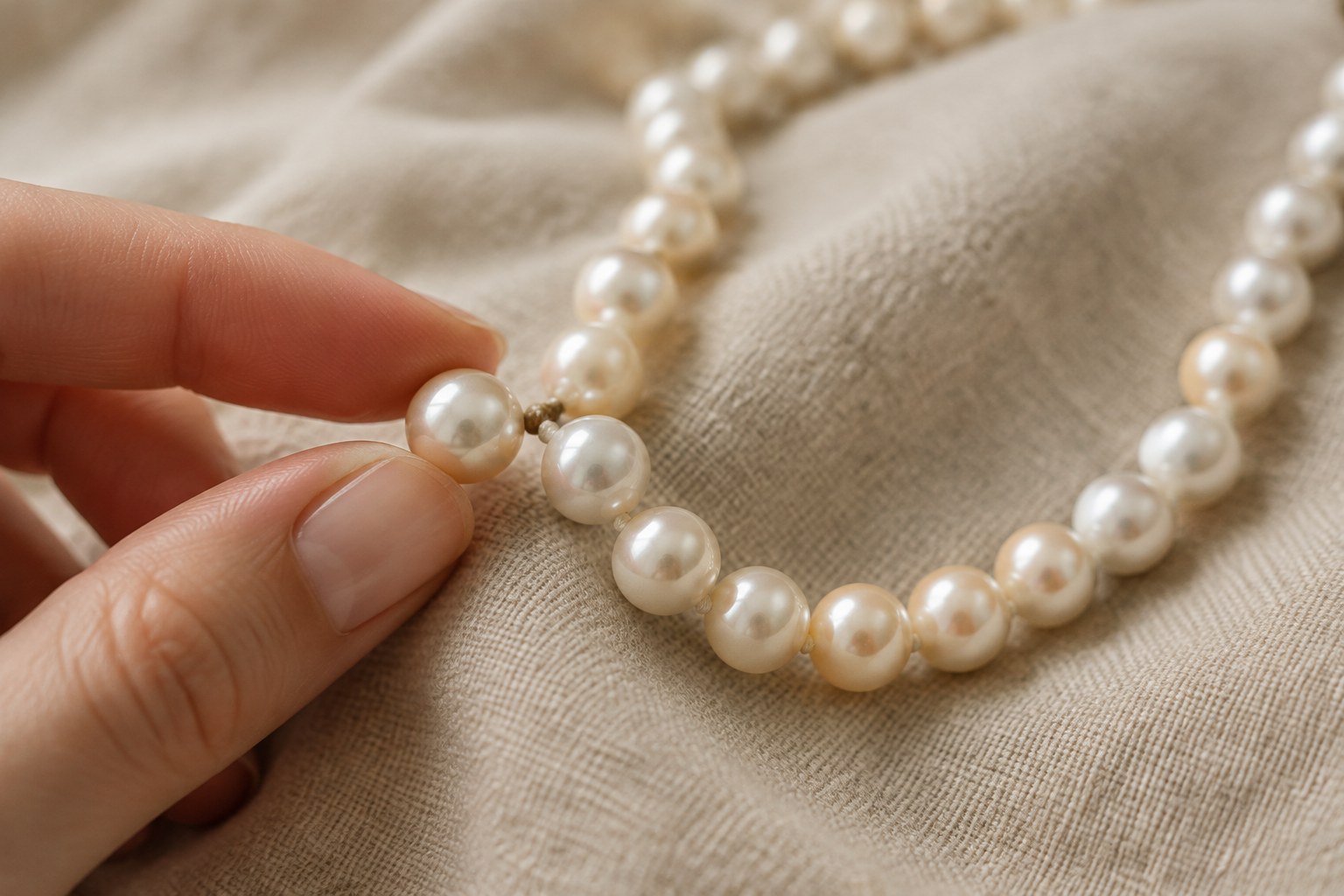
AI-generated illustration; not a Shewah product or a scale measurement.
SHEWAH Editorial Concept Illustration (Non-Catalogue)
Pearls are having a long moment, and with popularity comes imitation. Glass, plastic and shell-based lookalikes have become convincing enough that weight and shine alone can mislead. The good news: you do not need a laboratory to make a sensible first judgement. A few quiet checks, done in good light with clean hands, will tell you most of what you need to know.
Start with lustre, not shine
A real pearl's glow comes from nacre, thousands of microscopic aragonite platelets laid down by the mollusc over months or years. Light does not simply bounce off it; it travels into the surface and back, which is why genuine pearls seem lit from within and show subtle overtones of pink, silver or cream as you turn them. Imitations tend to have a single, uniform gloss, more like nail varnish than skin. Hold the strand near a window and roll it slowly. Real pearls shift in character; fakes stay flat.
The tooth test, done properly
The most famous check is also the most abused. Rub a pearl very lightly against the biting edge of a front tooth. Genuine nacre feels faintly gritty or sandy, because of those layered platelets, while glass and plastic feel glassy-smooth. Gemmologist Dr Tehmina Goskar confirms the test works, with two caveats: be gentle, because rubbing hard can mark softer pearls, and be hygienic, especially with pearls that are not yours. An alternative with the same logic is to rub two pearls from the strand lightly against each other. Real nacre produces the same fine friction and may leave a whisper of pearl powder, which wipes away without a trace. Imitation coatings either skid or, worse, flake.
Look closely at the surface
Nature does not do perfect. Under a magnifier or a phone camera zoom, real pearls show faint ridges, tiny pits, slight variations in shape from pearl to pearl. A strand where every bead is identical in size, colour and mirror-smooth finish is a strand to question. There is a small twist here: the very finest natural pearls can be near-perfect, so perfection alone is not proof of fakery. It is simply a prompt to run the other checks.
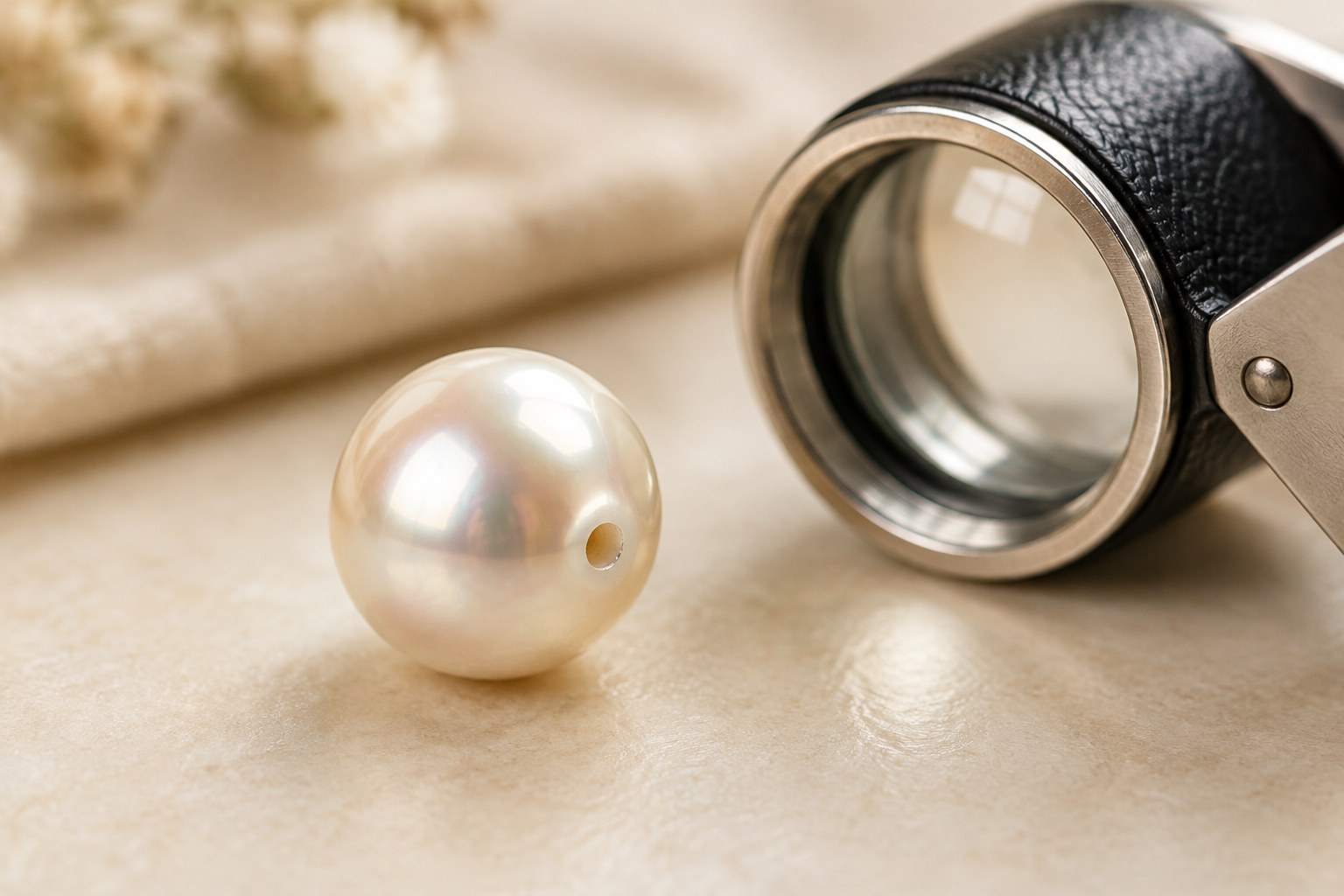
AI-generated illustration; not a Shewah product or a scale measurement.
SHEWAH Editorial Concept Illustration (Non-Catalogue)
Check the drill holes
This is the detail sellers of fakes most often neglect. On a genuine pearl the nacre continues cleanly into the drill hole, with a sharp, neat edge. On imitations the coating is often thin at the hole, so you may see chipping, a build-up of paint-like material, or a glimpse of glass or shell underneath. A ten-second look through a loupe at the clasp end of a strand is one of the most reliable home tests there is.
Weight and temperature
Real pearls are dense. A genuine strand settles into the palm with a satisfying heft that plastic cannot match, and pearls feel cool against the skin for the first few seconds before warming to you. Glass can mimic the coolness but rarely the weight; plastic manages neither.
When to call a gemmologist
Home tests are excellent filters, but they have limits. High-end shell pearls can pass several of them, and old, valuable strands deserve more than a tooth. If a purchase matters, ask for a report from an independent gemmological laboratory, which can X-ray a pearl to reveal whether it is natural, cultured or imitation, and whether it is beaded or non-beaded. A reputable seller will never object to the question.
Find pearls worth testing with Shewah
At Shewah we believe confidence is part of beauty: knowing what you wear, and why it deserves you. Whether your heart is set on pearls or on the quiet fire of lab-grown diamonds, our atelier in Surat is glad to talk you through materials, certificates and care. Explore Shewah's jewellery, or message us on WhatsApp at +91 96622 66360 for a personal consultation.
AI-generated illustration; not a Shewah product or a scale measurement.
SHEWAH Editorial Concept Illustration (Non-Catalogue)
Sources
- Should you rub pearls against your teeth? - Dr. Tehmina Goskar
- Pearl Tooth Test: Does It Really Work? - The Pearl Expert
- How to Tell if Pearls are Real - Brilliant Earth
The Maison Shewah Atelier Standard
Every creation referenced across our journal essays is made individually to order using solid 18K gold and independently certified diamonds (IGI & GIA). We uphold complete material transparency and zero synthetic plating.
Research & Gemological References
- [1]Should you rub pearls against your teeth? — Dr. Tehmina Goskar (Verified: 2026-10-25)
- [2]Pearl Tooth Test: Does It Really Work? — The Pearl Expert (Verified: 2026-10-25)
- [3]How to Tell if Pearls are Real — Brilliant Earth (Verified: 2026-10-25)


