How to Tell If Gold Is Real: Simple Tests That Work
“Hallmarks, magnets, ceramic streaks and the density trick Archimedes used on a crown: simple ways to check whether your gold is real.”
AI-generated illustration; not a Shewah product or a scale measurement.
SHEWAH Editorial Concept Illustration (Non-Catalogue)
Gold has been faked for as long as it has been treasured; even kings were fooled by counterfeits. If you have inherited a piece, bought vintage, or simply want peace of mind about a chain or ring, a handful of simple checks will tell you a great deal before you ever visit a professional. Here is how to tell if gold is real, from the thirty-second glances to the clever old physics.
Start with the hallmark
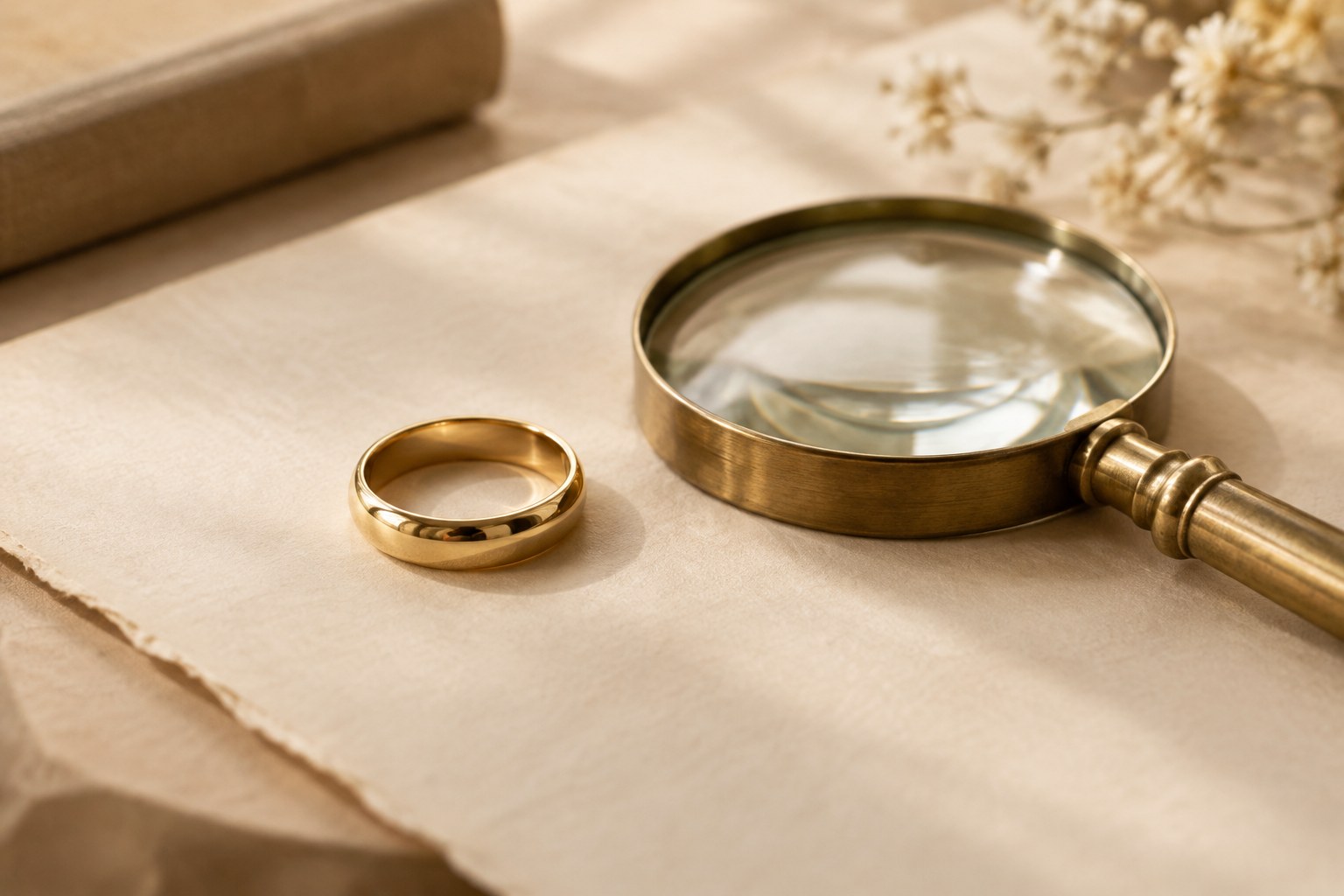
The first check is the stamp. Real gold jewellery almost always carries a hallmark or fineness mark indicating its purity, such as 18K, 14K or 750, struck into an inconspicuous spot like the inside of a band or the clasp of a chain. Look at it under good light or a magnifier. Be aware of two things: a missing hallmark is a question, not a verdict, since marks wear away and some countries never required them; and a present hallmark proves little alone, because determined fakes carry counterfeit stamps.
The magnet test
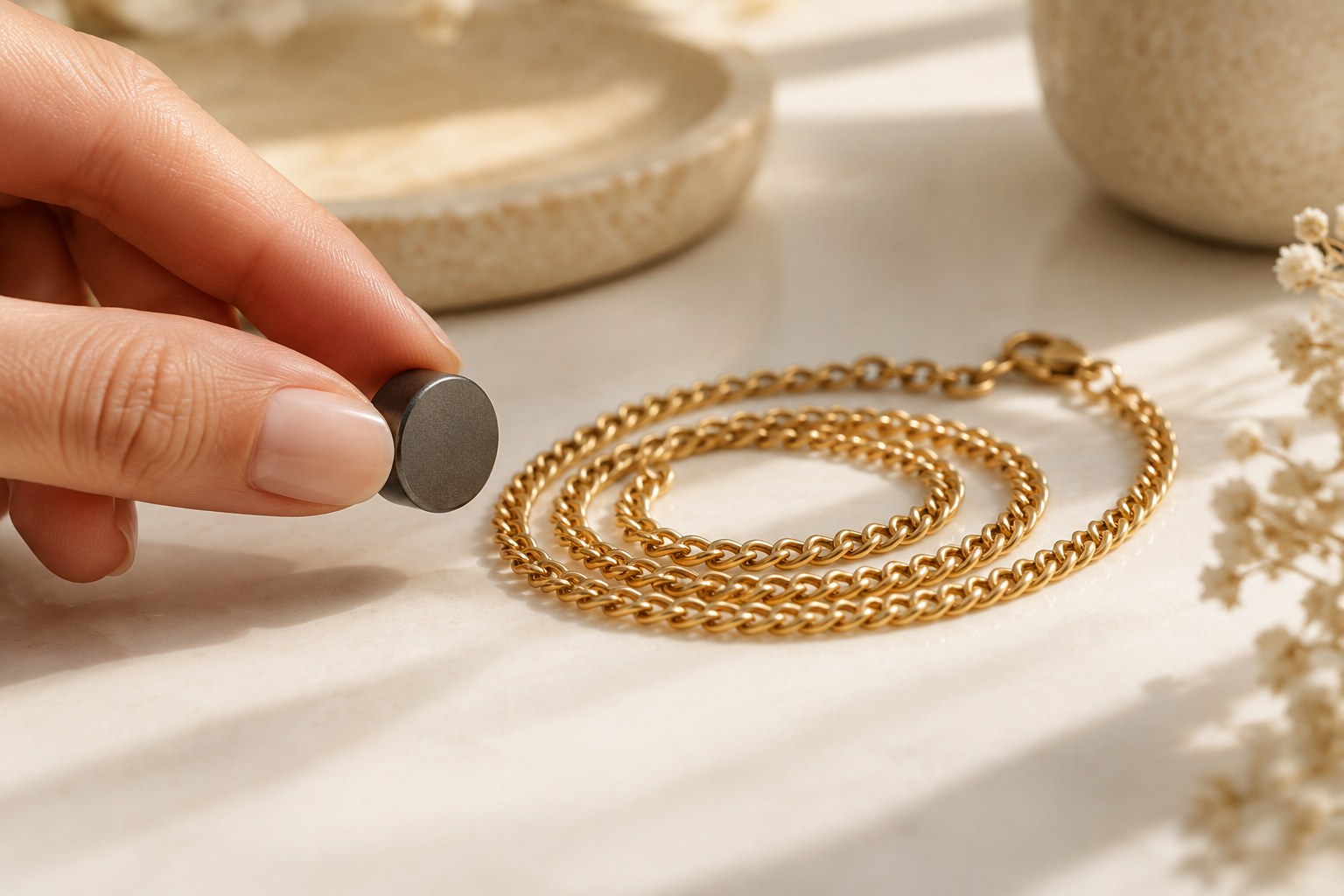
Gold is not magnetic, so hold a strong magnet near the piece, a proper magnet rather than a weak fridge souvenir. If the jewellery pulls toward it, there is a substantial amount of another metal inside and it is not solid gold. Passing the magnet test is encouraging but not conclusive, since some metals used in convincing fakes are also non-magnetic. Treat it as a fast filter, not a final answer.
The ceramic streak test
Take a piece of unglazed ceramic, the rough base of a tile or plate works, and gently drag the gold across it. Real gold leaves a yellowish streak; a black or grey streak points to another metal entirely. Use a light touch and an inconspicuous spot, because any streak test is mildly abrasive.
AI-generated illustration; not a Shewah product or a scale measurement.
SHEWAH Editorial Concept Illustration (Non-Catalogue)
The density test
The cleverest home test is also the oldest. When the king of Syracuse doubted his gold crown, Archimedes used density to settle it: gold is extraordinarily dense, far heavier for its size than the metals typically used to fake it. At home, weigh the piece, then measure the water it displaces, and compare. Genuine gold sinks fast and dense; a gold-plated piece over a lighter core gives itself away in the numbers. One caution: tungsten comes close to gold's weight, which is why professionals still get fooled.
What about the bite test?
The cowboy-film classic has a kernel of truth: gold is soft, and a hard bite can mark it. But other soft metals mark just as easily, and the force needed risks your teeth far more than it proves your gold. Leave this one to the films.
When to call a professional
Home tests narrow the field; they rarely close the case. If results conflict or the piece matters, a jeweller or appraiser can run acid tests, electronic verification and X-ray fluorescence that settle composition precisely. And the best defence comes first: buy from established, reputable sellers who stand behind what they sell, with documentation that matches the piece.
Gold you can trust from Shewah
Shewah crafts jewellery in solid gold with certified lab-grown diamonds, made to order in Surat and shipped to the US, UK and Australia, with the purity of every piece documented. Explore Shewah's jewellery or message us on WhatsApp at +91 96622 66360 to choose gold you never have to second-guess.
AI-generated illustration; not a Shewah product or a scale measurement.
SHEWAH Editorial Concept Illustration (Non-Catalogue)
Sources
The Maison Shewah Atelier Standard
Every creation referenced across our journal essays is made individually to order using solid 18K gold and independently certified diamonds (IGI & GIA). We uphold complete material transparency and zero synthetic plating.
Research & Gemological References
- [1]How Can I Tell if My Gold is Real or Gold-Plated? — APMEX (Verified: 2026-10-24)
- [2]Checking the Authenticity of Gold — Brogle (Verified: 2026-10-24)


