How to Tell If a Diamond Is Real: At-Home Checks That Work
“From the fog test to a $15 thermal tester, here are the at-home checks that separate diamonds from fakes, and the one verdict only a laboratory can give.”
AI-generated illustration; not a Shewah product or a scale measurement.
SHEWAH Editorial Concept Illustration (Non-Catalogue)
Maybe you inherited a ring, received a gift, or found a stone whose story you do not know. Before you pay for an appraisal, a handful of simple checks can tell you a surprising amount about whether a white stone is really diamond. None replaces a laboratory, but together they sort most fakes from the real thing.
What "real" actually means
A fake diamond is usually a simulant: a different material that merely looks the part. The usual suspects are cubic zirconia, moissanite, white sapphire, white topaz, zircon, quartz and plain glass. Each has different physical properties from diamond, and the tests below exploit those differences. Note that lab-grown diamonds are real diamonds, chemically and optically identical to mined ones; no home test can or should separate those two.
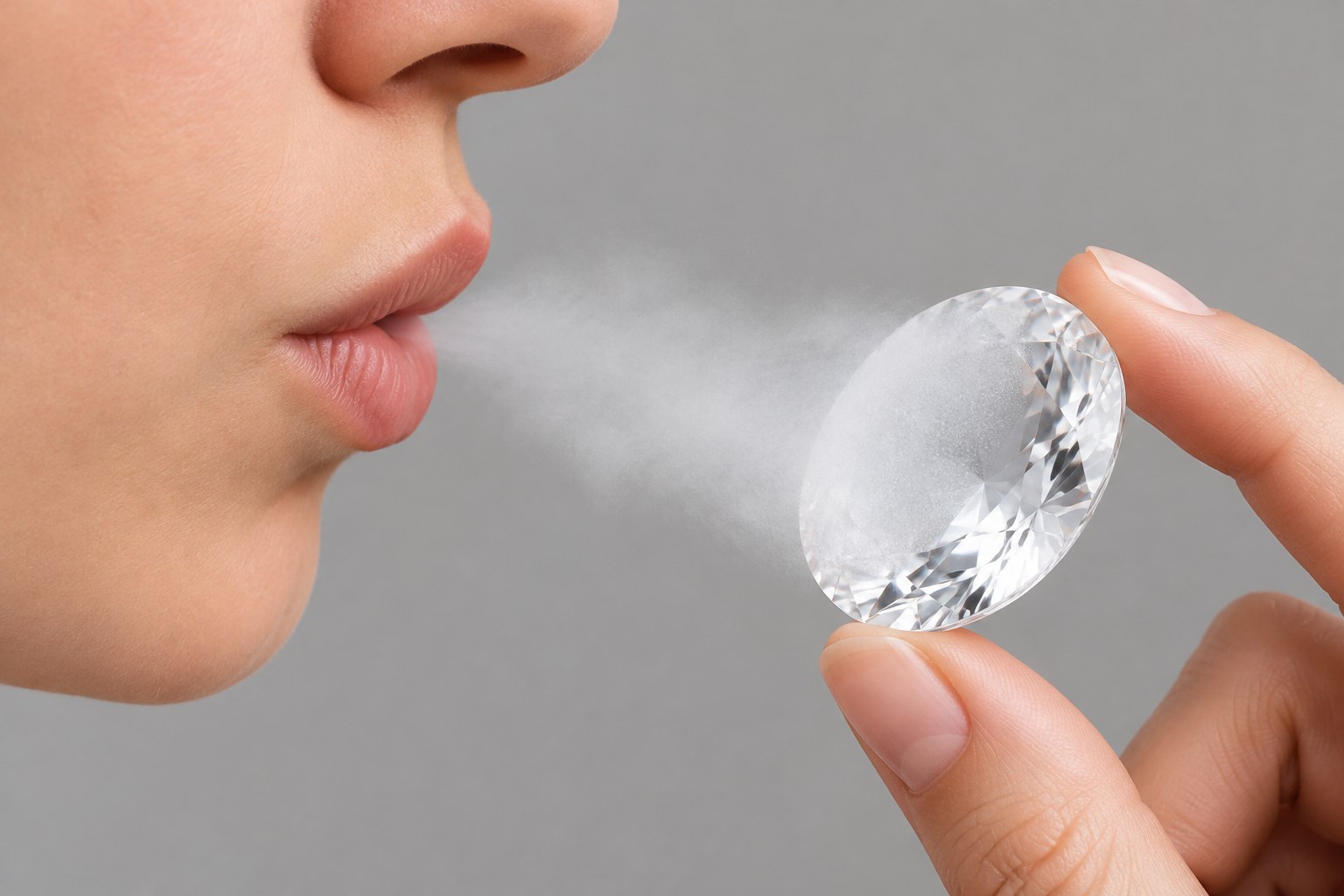
The fog test
Breathe on the stone as you would fog a mirror. Diamond disperses heat so efficiently that the mist vanishes almost instantly. If the stone stays fogged for a few seconds, as glass or cubic zirconia does, be suspicious.
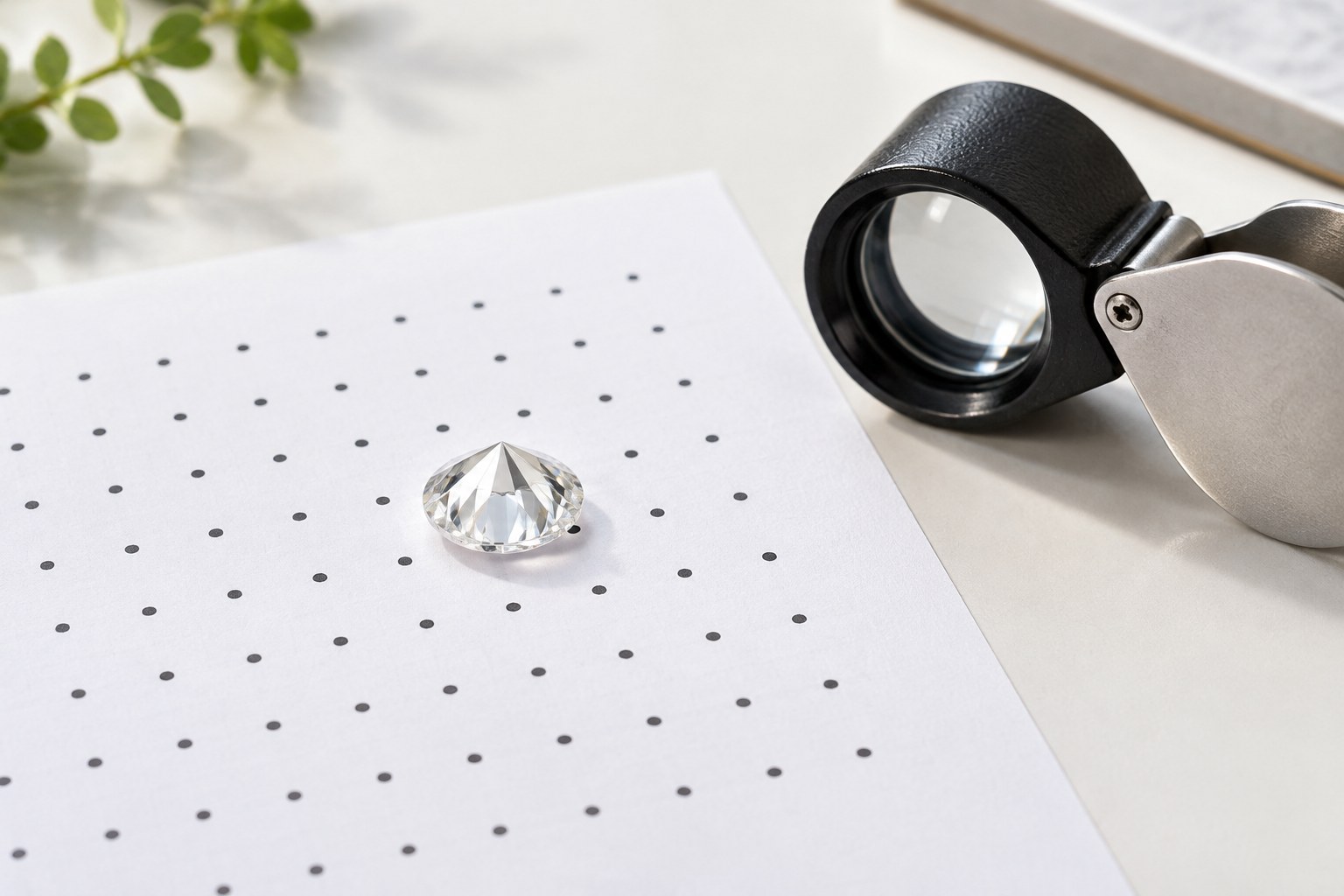
The dot test
For a loose stone only: place it face-down over a small dot or a line of newsprint. Diamond bends light so strongly that the dot disappears entirely. If you can make out the shape of the letters, even distorted, the stone is not a diamond.
AI-generated illustration; not a Shewah product or a scale measurement.
SHEWAH Editorial Concept Illustration (Non-Catalogue)
Facet doubling under a loupe
Through a jeweller's loupe, look through the top of the stone at the back facets. Diamond is singly refractive, so facet edges stay crisp and single. Many imitations are doubly refractive and show fuzzy, doubled facet lines: obvious in zircon, subtler in moissanite and white sapphire. Crisp single facets point toward diamond, though cubic zirconia and glass can pass this check too.
Ultraviolet fluorescence
In a dark room, shine a blacklight on the stone. Many diamonds fluoresce blue. A glow of another colour suggests an imitation, while no reaction at all proves nothing either way. Treat this as a supporting clue, not a verdict.
Sharp edges and sparkle
Two quieter clues reward a trained eye. Diamond takes an exceptionally sharp polish, so facet edges look knife-crisp where glass and softer simulants wear rounded. And a diamond's fire sits in a characteristic range: noticeably more rainbow than white sapphire, noticeably less than cubic zirconia, which flashes almost too colourfully.
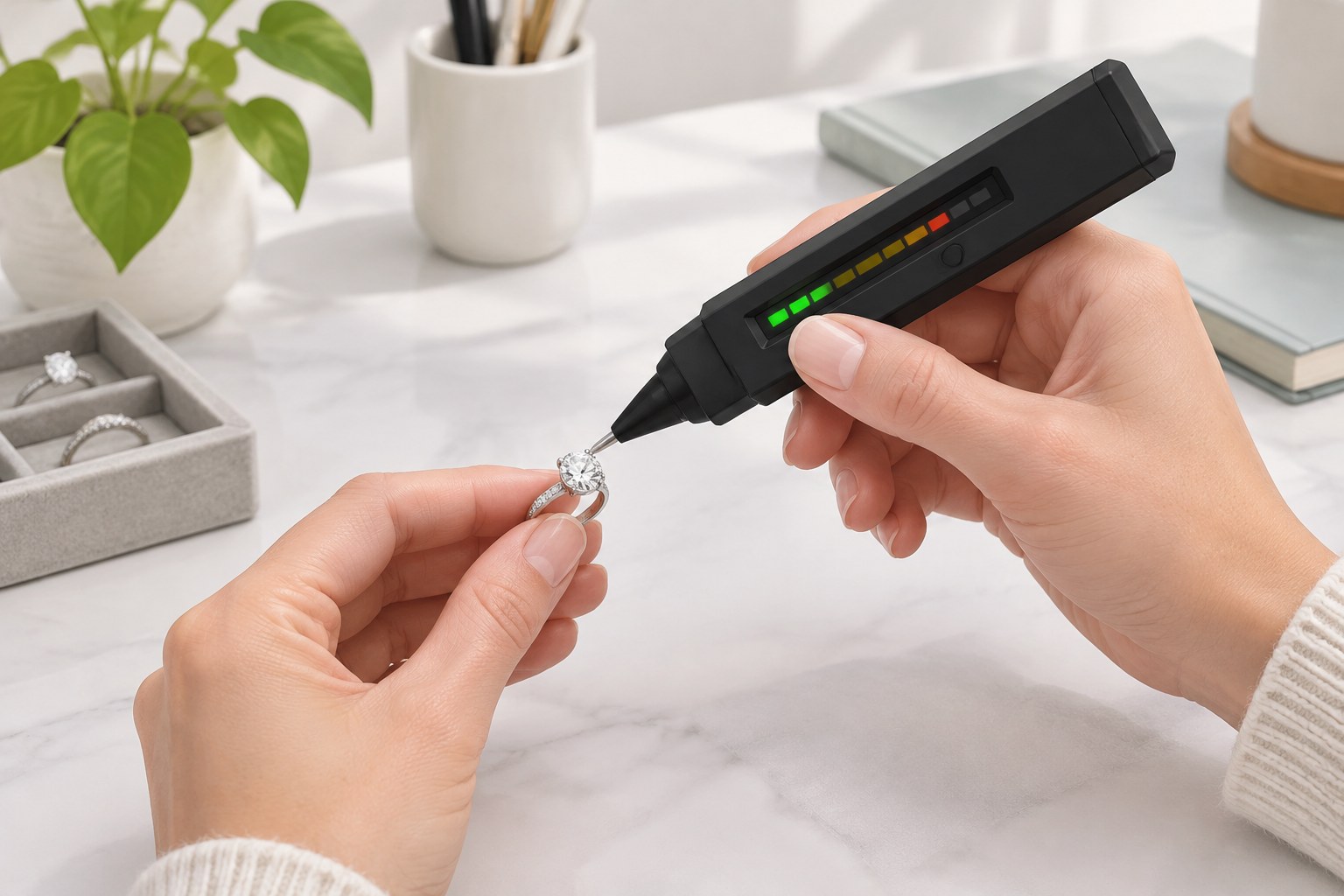
The thermal tester: the best home check
A pocket diamond tester costs around $15 online and measures thermal conductivity in about thirty seconds. It is the strongest home test, but know its blind spot: it reads positive for both diamond and moissanite, which conducts heat similarly. Separating those two needs an electrical conductivity test or a professional.
What no home test can do
Home tests sort diamonds from simulants reasonably well. What they cannot do is tell a lab-grown diamond from a mined one, because they are the same material; only a gemmological laboratory can make that call. If the answer carries real money, a laboratory report is the only verdict that counts.
The safest test of all: how you buy
The truly reliable check happens before purchase. Buy from a reputable seller with a clear return policy, and expect a grading report from an independent gemmological laboratory for any significant stone. An honest seller treats that expectation as normal.
Buy with certainty at Shewah
Every Shewah diamond is a certified lab-grown diamond with an independent grading report, set in solid gold, made to order in Surat and shipped to the US, UK and Australia. Explore Shewah's jewellery or message us on WhatsApp at +91 96622 66360.
AI-generated illustration; not a Shewah product or a scale measurement.
SHEWAH Editorial Concept Illustration (Non-Catalogue)
Sources
- How to Spot a Fake Diamond: What These 13 Tests Really Mean - International Gem Society
- Distinguishing Diamonds: Educating Your Eyes - International Gem Society
The Maison Shewah Atelier Standard
Every creation referenced across our journal essays is made individually to order using solid 18K gold and independently certified diamonds (IGI & GIA). We uphold complete material transparency and zero synthetic plating.
Research & Gemological References
- [1]How to Spot a Fake Diamond: What These 13 Tests Really Mean — International Gem Society (Verified: 2026-10-20)
- [2]Distinguishing Diamonds: Educating Your Eyes — International Gem Society (Verified: 2026-10-20)


