How to Measure Ring Size at Home: A Practical Guide
“Learn how to estimate ring size at home, measure an existing ring and confirm the right fit before ordering, with an approximate US size chart.”

AI-generated illustration; not a Shewah product or a scale measurement.
SHEWAH Editorial Concept Illustration (Non-Catalogue)
A ring should feel secure without pinching, and slide over your knuckle without a struggle. If you are shopping online, a little preparation helps you choose the size with fewer surprises.
The most reliable way to find your ring size is to have a jeweller measure the intended finger with a ring sizer. At home, a properly used sizing tool or the inside diameter of a well-fitting ring can help you estimate it. Paper and string are less reliable, so treat those measurements as a starting point, not a final order size.
This guide explains what to measure, how to read the result and what to confirm before ordering a ring.
Before you measure
Choose the exact finger and hand where you will wear the ring. A ring that fits one finger is not proof that it will fit another, even on the opposite hand.
Measure when your hands are at a comfortable temperature. Cold can make fingers smaller; heat can make them swell. If your measurements vary, repeat them at different times and share the range with your jeweller.
Think about the design too. A broad wedding band or a stack of rings can feel tighter than a narrow band. For a custom order, confirm the fit using a sizer close to the width of the finished ring.
Method 1: Use a ring sizer
A ring sizer tests the fit on your finger, rather than asking you to translate a ruler reading into a size.
- Check which sizing system the tool uses, such as US numbers or UK letters.
- Try it on the intended finger and follow the tool's instructions.
- Make sure it passes over the knuckle and sits comfortably at the base.
- Check that it does not pinch or slip off easily.
- Record the size, sizing system and the width of the sizer used.
A jeweller's set of finger gauges is a better final check than a homemade strip. If your knuckle is noticeably larger than the base of your finger, ask the jeweller to assess both rather than choosing from the base measurement alone.
Method 2: Measure a ring you already wear
This is useful when you have a round ring that fits the same finger well.
Lay the ring flat and measure its inside diameter in millimetres. Measure straight across the centre of the opening, from one inner edge to the other. Do not include the metal band in the measurement.
For example, an inside diameter of about 17.3 mm is approximately a US size 7 on the reference chart below. Measuring the outside edge instead would make the ring appear larger than it is.
Check the result against the jeweller's own chart before ordering. If the ring is bent, oval or unusually wide, take it to a jeweller for measurement instead of relying on a ruler.
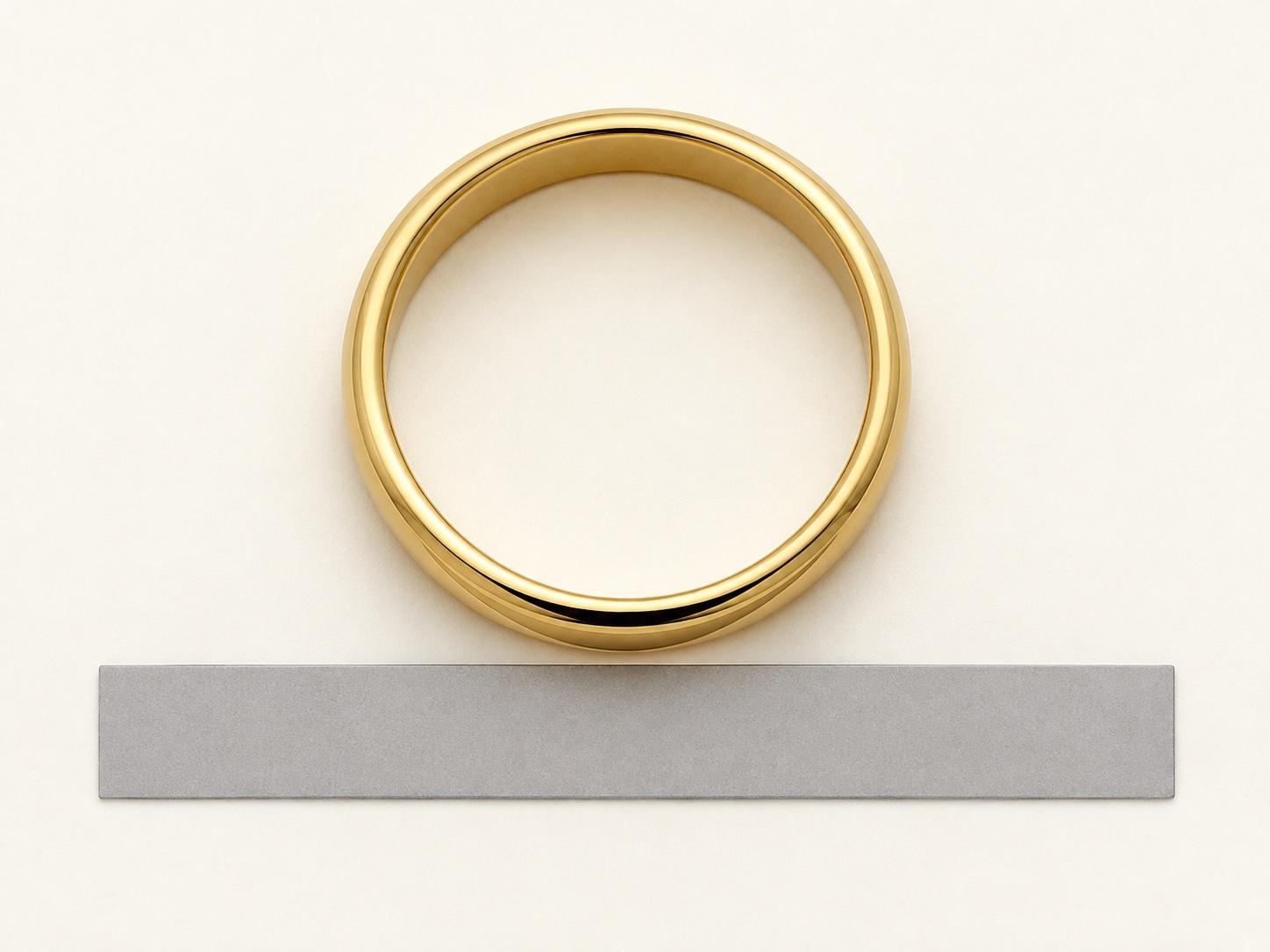
AI-generated illustration; not a Shewah product or a scale measurement.
SHEWAH Editorial Concept Illustration (Non-Catalogue)
Method 3: Paper or string, for an estimate only
If you have no sizer or suitable ring, a paper strip can give you a rough finger-circumference measurement.
- Wrap a narrow strip around the base of the intended finger without pulling it tight.
- Mark where the ends meet.
- Lay it flat and measure to the mark in millimetres.
- Repeat to see whether the readings are consistent.
The result is a circumference, not a diameter. Keep that distinction when you use a chart.
There is an important limit: string can stretch, paper can bend or change shape, and neither method tests how a rigid ring passes over your knuckle. GIA warns that these methods can give inaccurate results. Use the estimate to start a conversation with your jeweller, then confirm the fit with a proper sizer before committing to a made-to-order ring.
Ring size chart: approximate US sizes
These rounded reference measurements are from GIA's ring-size guide. They are estimates for comparison, not a substitute for a fit check.
| US size | Inside diameter | Inside circumference | | --- | --- | --- | | 4 | 14.9 mm | 46.8 mm | | 5 | 15.7 mm | 49.3 mm | | 6 | 16.5 mm | 51.8 mm | | 7 | 17.3 mm | 54.3 mm | | 8 | 18.1 mm | 56.9 mm | | 9 | 19.0 mm | 59.7 mm | | 10 | 19.8 mm | 62.2 mm | | 11 | 20.6 mm | 64.7 mm | | 12 | 21.4 mm | 67.2 mm |
Half sizes also exist. If your reading falls between these rows, do not automatically round to the next whole size. Ask your jeweller which size suits your measurement and ring design.
Buying from the UK or Australia?
US sizes use numbers, while UK and Australian charts commonly use letters. Do not send a bare number or letter without naming the system.
Letter conversions can differ between published charts. For an international order, share the inside measurement in millimetres, the chart you used and your usual local size. Have the jeweller confirm the final order size in writing.
Four mistakes to avoid
- Measuring the wrong hand or finger. Use the finger where the ring will actually sit.
- Including the band in a diameter reading. Measure the opening, not the outside of the ring.
- Ignoring the knuckle. A comfortable fit at the base is not enough if the ring cannot pass over the joint.
- Using a narrow-ring size for every design. Wide bands and ring stacks need their own fit check.
Buying a ring as a surprise
If possible, use a ring the recipient already wears on the intended finger and take it to a jeweller. Explain which hand it is worn on and whether the new design is wider.
Do not guess from height, clothing size or a photograph. An estimate is still an estimate, so confirm alteration and return terms for the particular ring before ordering.
Frequently asked questions
What is the most accurate way to measure ring size?
Have a jeweller measure your finger with finger gauges and assess the fit for your chosen design. A well-fitting existing ring can also be checked on a ring mandrel.
Can I measure ring size with my phone?
Do not assume an on-screen circle is to scale. Check the tool's calibration instructions, and confirm the result with a physical sizer or jeweller before ordering.
Should I size up for a wide band?
A wider band can fit more snugly, but there is no single size increase that suits every ring and finger. Ask for a fit check using a similar-width sizer rather than automatically adding a whole size.
What if I am between sizes?
Check whether half sizes are available and discuss the design with your jeweller. The goal is a ring that clears the knuckle and feels secure at the base, not simply the closest chart number.
Can my ring be resized later?
Ask before ordering. Do not assume every design can be resized or that an alteration is included in the price. Get the options, cost and order terms for your specific ring in writing.
Plan your ring with Shewah
For a custom ring, start with the design you love and a size you have checked. Share your usual sizing system, your measurement method and whether you want a slim band, a wider band or a ring stack.
Explore Shewah's jewellery, then contact us on WhatsApp at +91 96622 66360 to discuss your ring design and sizing details before ordering.
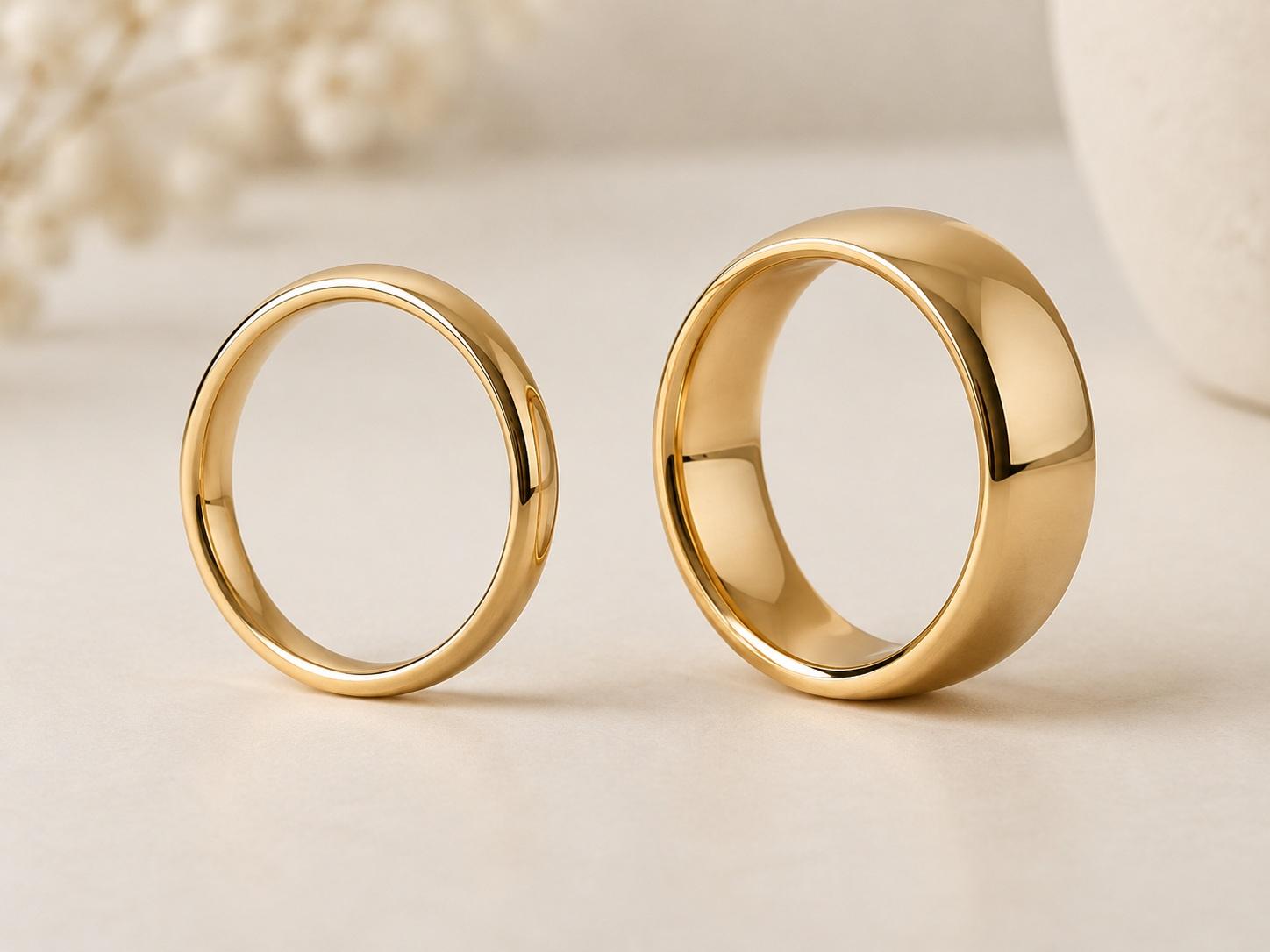
AI-generated illustration; not a Shewah product or a scale measurement.
SHEWAH Editorial Concept Illustration (Non-Catalogue)
Sources
The Maison Shewah Atelier Standard
Every creation referenced across our journal essays is made individually to order using solid 18K gold and independently certified diamonds (IGI & GIA). We uphold complete material transparency and zero synthetic plating.
Research & Gemological References
- [1]Ring Size Guide: Tips and Ring Size Chart — GIA (Verified: 2026-10-12)
- [2]Accurate Determination of Finger and Ring Sizes — GIA (Verified: 2026-10-12)
- [3]Size Guide — Tiffany & Co. Australia (Verified: 2026-10-12)


