How Much Should You Spend on an Engagement Ring?
“Set an engagement-ring budget without salary rules. See hypothetical US dollar examples, compare quotes and plan for the full cost before buying.”

AI-generated illustration; not a Shewah product or a scale measurement.
SHEWAH Editorial Concept Illustration (Non-Catalogue)
Spend an amount you can comfortably afford on a ring your partner will enjoy wearing. There is no compulsory salary multiple, minimum carat weight or price that proves commitment.
GIA's engagement-ring cost guide also rejects a hard-and-fast spending rule. A useful budget starts with your finances and the design you want, not somebody else's average.
This guide explains how to set a total budget, compare rings on the same terms and decide where to focus your money. The US dollar figures below are hypothetical planning examples, not Shewah prices or current market quotes.
Start with the amount you can afford
Before looking at stones, decide how much you can spend without compromising essential bills, savings goals or other plans you share. If you are buying together, discuss that amount before comparing designs.
Separate the money available now from money you hope to have later. A ring budget should not depend on an uncertain bonus or a future sale of the ring.
Write down a comfortable target and a firm maximum. If a quote exceeds the maximum, change the brief rather than treating the extra cost as proof that you care more.
Ignore the three-month salary rule
A salary multiple is not a personal financial plan. It does not account for living costs, dependants, existing commitments or the kind of ring your partner wants.
Two people with the same income can sensibly choose very different ring budgets. The right choice is the one that works for your situation and reflects a shared preference.
Do not let a headline average set your minimum either. Average spending cannot tell you whether a particular ring is suitable or affordable for you.
Budget for the whole order
Ask for an all-in quote rather than a centre-stone price alone. Confirm which items are included and which are extra:
- The centre stone and any accent stones.
- The setting and stated metal alloy.
- Design work, engraving or other requested details.
- Applicable taxes and delivery charges.
- Any import charges relevant to the destination.
- Alterations, rush requests or other optional services.
Not every order has every charge. The point is to get an itemised answer, not to add a guessed allowance and assume it covers everything.
If you want insurance, request an actual insurance quote separately. Confirm what documentation the insurer needs and do not assume a laboratory report is itself an insurance valuation.
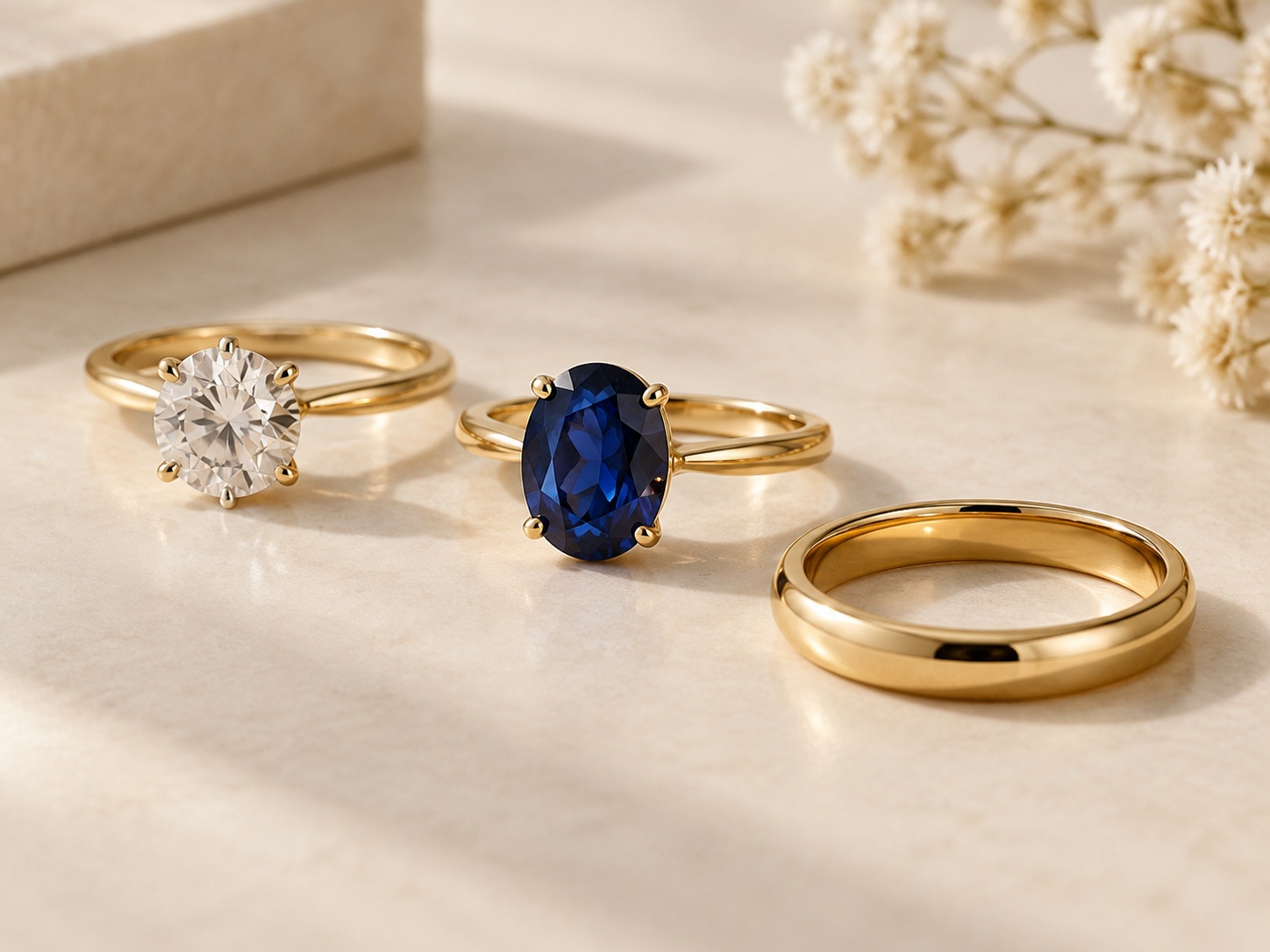
AI-generated illustration; not a Shewah product or a scale measurement.
SHEWAH Editorial Concept Illustration (Non-Catalogue)
Three hypothetical US dollar examples
These examples show how to calculate a ceiling. They do not predict what stone, metal or ring you can buy at that price. The reserved amounts are arbitrary planning allowances and must be replaced with real quotes.
Example A: A $1,500 total ceiling
Suppose you can comfortably spend $1,500 in total and initially reserve $150 for quoted extras. Your ring-price target is then $1,350.
If actual taxes and delivery cost $220, the available ring amount becomes $1,280. Adjust the ring choice before ordering instead of quietly exceeding the total.
Example B: A $3,000 total ceiling
Suppose you set a $3,000 maximum and provisionally reserve $300 for extras. Start comparing ring quotes at $2,700 or below.
One quote might include engraving and delivery while another does not. Ask for the final payable amount for each before deciding which is better value.
Example C: A $5,000 total ceiling
Suppose your total is $5,000 and your provisional reserve is $500. That leaves $4,500 for the ring while you obtain the actual additional charges.
The higher ceiling does not mean every part should be upgraded. If the wearer prefers a compact ring, use that preference to guide the design instead of buying a larger stone simply because the budget allows it.
Decide what matters most in the finished ring
Choose your priorities before comparing detailed specifications. Is the main goal a particular stone shape, visible size, colour, setting profile or metal colour?
For diamonds, GIA recommends understanding the 4Cs: colour, clarity, cut and carat weight. These describe different aspects of the stone; no single number describes the whole ring.
Compare the actual appearance as well as the stated details. Ask for clear videos in ordinary lighting and measurements in millimetres. Carat is a weight, not the width of the stone on the finger.
If you compromise, do it deliberately. Reducing a specification that does not matter to you is different from accepting an unidentified stone or unclear order terms.
Compare natural and laboratory-grown options clearly
Ask the jeweller to state the diamond's origin in writing. Do not assume that a price, photograph or phrase such as "real diamond" establishes whether it is natural or laboratory-grown.
Request quotes for the options you are actually considering. Avoid relying on a universal discount percentage, because the final price depends on the particular stone, setting and order.
Ask what laboratory documentation is available and what it covers. Check the report with the issuing laboratory. A laboratory's name on a listing is not a substitute for the relevant document and stone details.
If you are considering a coloured gemstone instead, ask for its identity, origin information where available, disclosed treatments and care needs. Compare the complete design rather than assuming every gemstone behaves like a diamond.
Look at setting costs and daily wear
A simple-looking ring can still involve careful construction. A more decorative design may introduce extra stones, engraving or other work. Ask how each requested detail changes the quote.
Consider the setting height, band width and whether the ring needs to sit beside a future wedding band. Saving money on a design you will later want to change may not deliver the result you hoped for.
Have the intended finger sized and label the sizing system. For international orders, share millimetre measurements where available and ask the jeweller to confirm the final order size.
Compare quotes in a simple table
Put the quoted stone details, dimensions, metal, setting, total price and delivery estimate side by side. Include alteration and return terms, particularly for custom orders.
If two quotes differ substantially, ask what explains the difference. Do not automatically assume the more expensive ring is better or that the cheaper ring is equivalent.
Check whether a design illustration, sample photograph and finished product are being described as the same thing. For a custom ring, understand which details are fixed and which will be confirmed during design approval.
Frequently asked questions
Is three months' salary necessary?
No. Choose a budget based on your finances and preferences. GIA's cost guide does not treat a salary multiple as a required rule.
Is a smaller ring less meaningful?
No price or size can measure a relationship. Choose the ring the wearer wants and an amount you can afford.
Can I use these examples as price estimates?
No. They are budgeting arithmetic only. Get a current itemised quote for the actual stone, metal, design and destination before deciding.
Should I treat the ring as an investment?
Do not rely on future resale to justify today's spending. Buy within an affordable budget and ask separate questions about any resale or buyback terms rather than assuming value will increase.
What if the quote is above my maximum?
Change a design priority, compare another option or wait. Do not let a sales deadline override a spending limit you chose for a reason.
Discuss your budget with Shewah
Share your total budget, destination, preferred style and the features that matter most. Ask for the stone details, metal, dimensions and full payable quote before approving a custom order.
Explore Shewah's jewellery, or contact us on WhatsApp at +91 96622 66360 to discuss an engagement-ring design within your budget.
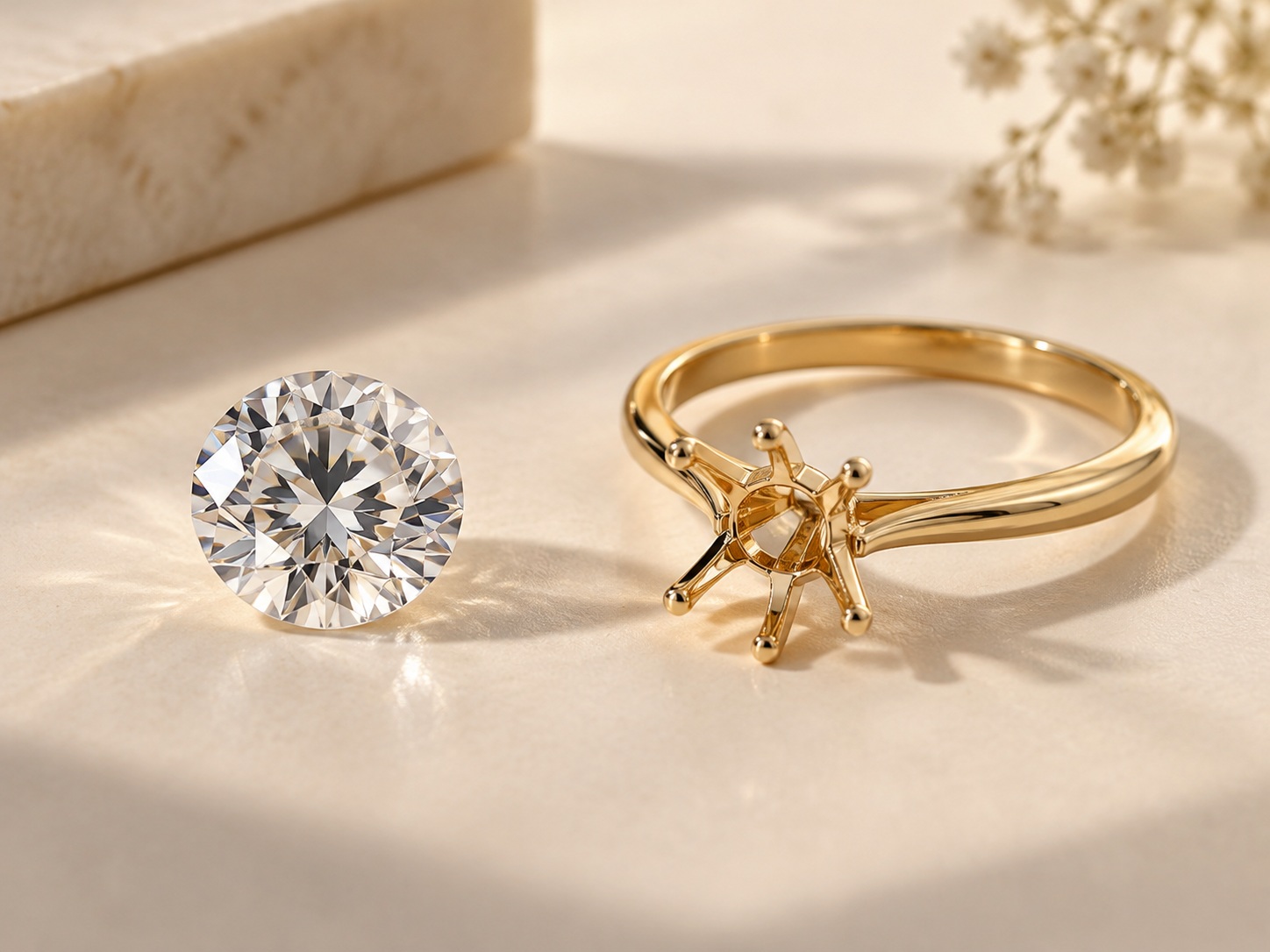
AI-generated illustration; not a Shewah product or a scale measurement.
SHEWAH Editorial Concept Illustration (Non-Catalogue)
Sources
The Maison Shewah Atelier Standard
Every creation referenced across our journal essays is made individually to order using solid 18K gold and independently certified diamonds (IGI & GIA). We uphold complete material transparency and zero synthetic plating.
Research & Gemological References
- [1]GIA: How Much Should a Diamond Engagement Ring Cost? — GIA (Verified: 2026-10-11)
- [2]GIA: 10 Tips for Buying an Engagement Ring — GIA (Verified: 2026-10-11)


