The History of Engagement Rings: From Ancient Rome to Lab-Grown Diamonds
“The engagement ring's real history: Roman iron hoops, the first diamond ring in 1477, the De Beers campaign that made diamonds standard, and today's choices.”

AI-generated illustration; not a Shewah product or a scale measurement.
SHEWAH Editorial Concept Illustration (Non-Catalogue)
Engagement rings feel timeless, but the tradition has a traceable history with a few genuine turning points: ancient Rome, a 15th-century archduke, and a 20th-century advertising campaign that changed what the world expects from a proposal. Here is the story, from iron hoops to lab-grown diamonds.
Ancient Rome: the betrothal ring
The engagement ring can only be reliably traced back to ancient Rome, where the betrothal ring was a plain iron hoop called the anulus pronubis. Among the gentry, the iron ring was worn indoors and swapped for a gold band outdoors. Roman writers recorded that the ring was worn on the fourth finger of the left hand, believed to contain a vein running directly to the heart, the vena amoris.
The tradition had legal weight early on. The mid-7th-century Visigothic Code treated the giving and accepting of the ring as binding the promise of marriage, and in 860 AD Pope Nicholas I described the Western custom of a man giving his betrothed an engagement ring.
1477: the first diamond engagement ring
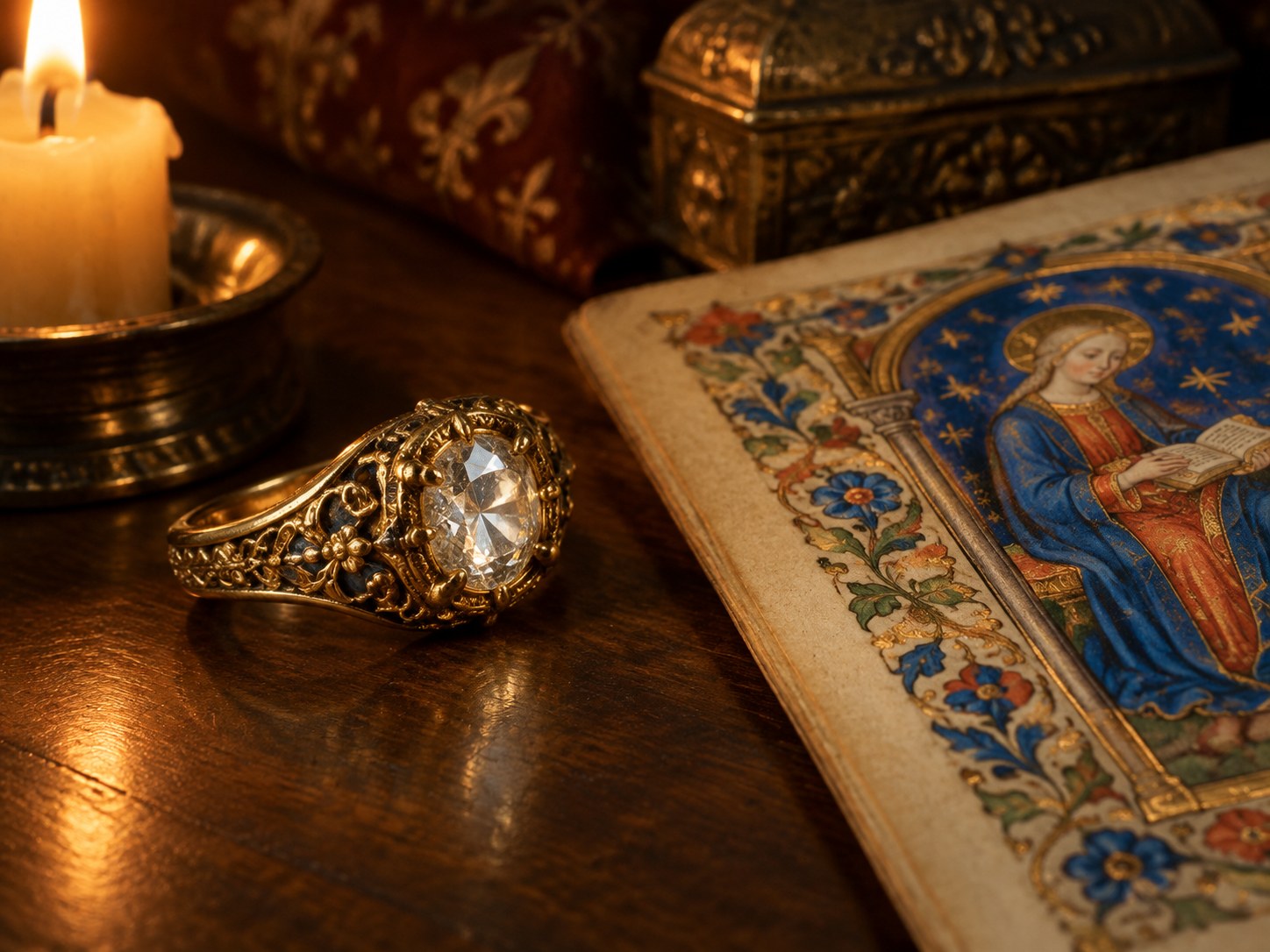
The first well-documented diamond engagement ring was given in 1477 by Archduke Maximilian of Austria on his betrothal to Mary of Burgundy. A Dr. Moroltinger had advised the future Holy Roman Emperor to have a ring set with a diamond, which, resisting fire and steel, stood for the fortitude of a lifelong partnership. The gesture set a fashion among European nobility, and diamonds began appearing in the betrothal rings of the wealthy.
Through the following centuries, engagement rings carried sapphires, rubies and diamonds in increasingly elaborate settings. The 16th century gave us the fede ring, two clasped hands signifying faith, and the gimmel ring, interlocking bands worn separately by the couple and joined at the wedding.
1938 to 1947: diamonds become the standard
For most of history, diamonds were only for the rich. Before World War II, just 10% of American engagement rings contained a diamond. Then came one of the most successful marketing campaigns ever run.
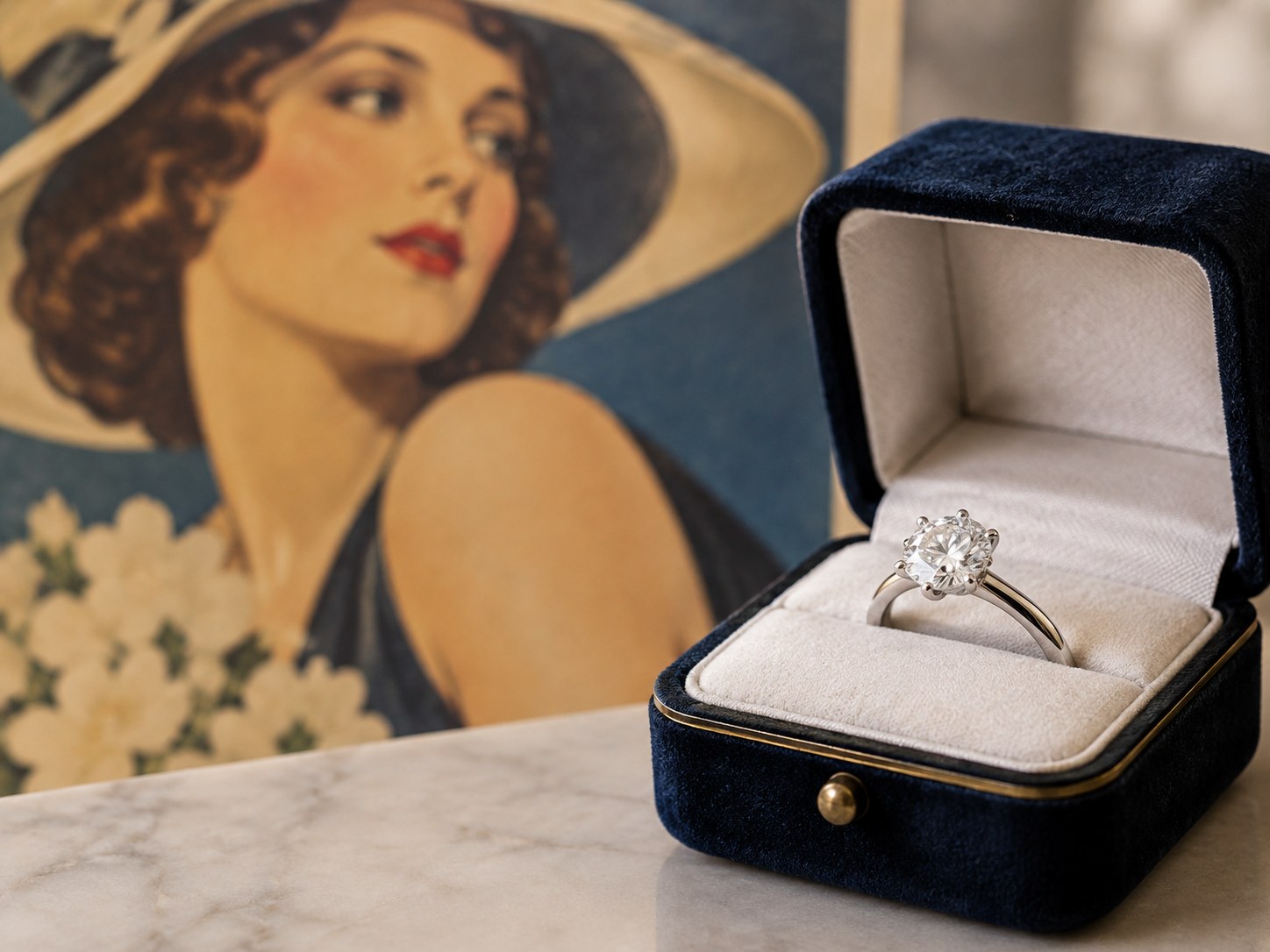
In 1938, De Beers began a campaign to rescue diamond sales, which had collapsed in the Great Depression. The campaign taught the public to judge diamonds by the 4Cs (cut, carat, colour, clarity) and, in 1947, introduced the slogan "A Diamond Is Forever." The message was that an engagement was incomplete without a diamond. Between 1939 and 1979, diamond sales in the United States rose from $23 million to $2.1 billion. The same campaign invented the spending rules, suggesting one month's salary in the 1930s and two months by the 1980s, figures with no basis beyond advertising.
AI-generated illustration; not a Shewah product or a scale measurement.
SHEWAH Editorial Concept Illustration (Non-Catalogue)
The modern era: choice again
The last two decades have loosened the diamond monopoly De Beers built. Lab-grown diamonds, chemically identical to mined ones, have made larger and better stones affordable to most couples. Coloured gemstones, antique cuts and custom design have returned as mainstream choices. In a way, the market has come full circle: before 1940, an engagement ring was whatever the couple chose it to be, and that is increasingly true again.
The average spend has normalised too. Industry figures put the US average around $4,000 in 2012, while a 2015 study found a third of couples spent under $2,000 and a quarter bought no ring at all. There has never been a correct amount, only a correct ring.
Write the next chapter with Shewah
The history of the engagement ring is a history of couples making the tradition their own. Tell us the era, the style or the story you love, and we will design a made-to-order ring in lab-grown diamonds, quoted before work begins.
Explore Shewah's jewellery or contact us on WhatsApp at +91 96622 66360 to begin your own piece of the story.
AI-generated illustration; not a Shewah product or a scale measurement.
SHEWAH Editorial Concept Illustration (Non-Catalogue)
Sources
- Engagement ring - Wikipedia
- Engagement Rings Through the Ages - GIA
The Maison Shewah Atelier Standard
Every creation referenced across our journal essays is made individually to order using solid 18K gold and independently certified diamonds (IGI & GIA). We uphold complete material transparency and zero synthetic plating.
Research & Gemological References
- [1]Engagement ring — Wikipedia (Verified: 2026-10-14)
- [2]Engagement Rings Through the Ages — GIA (Verified: 2026-10-14)


