Evil Eye Jewellery: Meaning, History and Why We Wear It
“The evil eye charm is not the curse; it is the cure. From 3,300 BC Mesopotamia to the modern nazar pendant, here is what the symbol means and why it is one of the most gifted motifs in jewellery.”
AI-generated illustration; not a Shewah product or a scale measurement.
SHEWAH Editorial Concept Illustration (Non-Catalogue)
Few symbols in jewellery are as instantly recognisable as the wide blue eye staring back from a pendant or bracelet. It is often called the evil eye, but that name hides a twist: the charm is not the curse. It is the cure. Here is what the symbol really means, where it comes from, and why it remains one of the most gifted motifs in jewellery.
The curse and the charm
Start with the distinction that matters. The evil eye itself is a curse: a malevolent glare, usually fuelled by envy, believed to bring misfortune to whoever receives it. Success attracts envy, the thinking goes, and envy can undo good fortune. The wide-eyed amulet worn in jewellery is the answer to that curse, a protective charm that reflects the glare back. The confusion between the two is understandable, since we casually call the amulet an "evil eye", but wearing one is an act of defence, not menace.
Five thousand years of watching
Amulets against the evil eye have been found dating back around 5,000 years. The earliest known versions, abstract alabaster idols with incised eyes, were excavated at Tell Brak, one of the oldest cities of Mesopotamia, and date to about 3,300 BC. In ancient Egypt, the Eye of Horus was buried with pharaohs to protect them in the afterlife. When glass bead production spread through the Mediterranean around 1500 BC, eye beads travelled with traders to Phoenician, Persian, Greek, Roman and Ottoman hands. Few ideas in human history have been worn so consistently, by so many cultures, for so long.
The nazar and its cousins
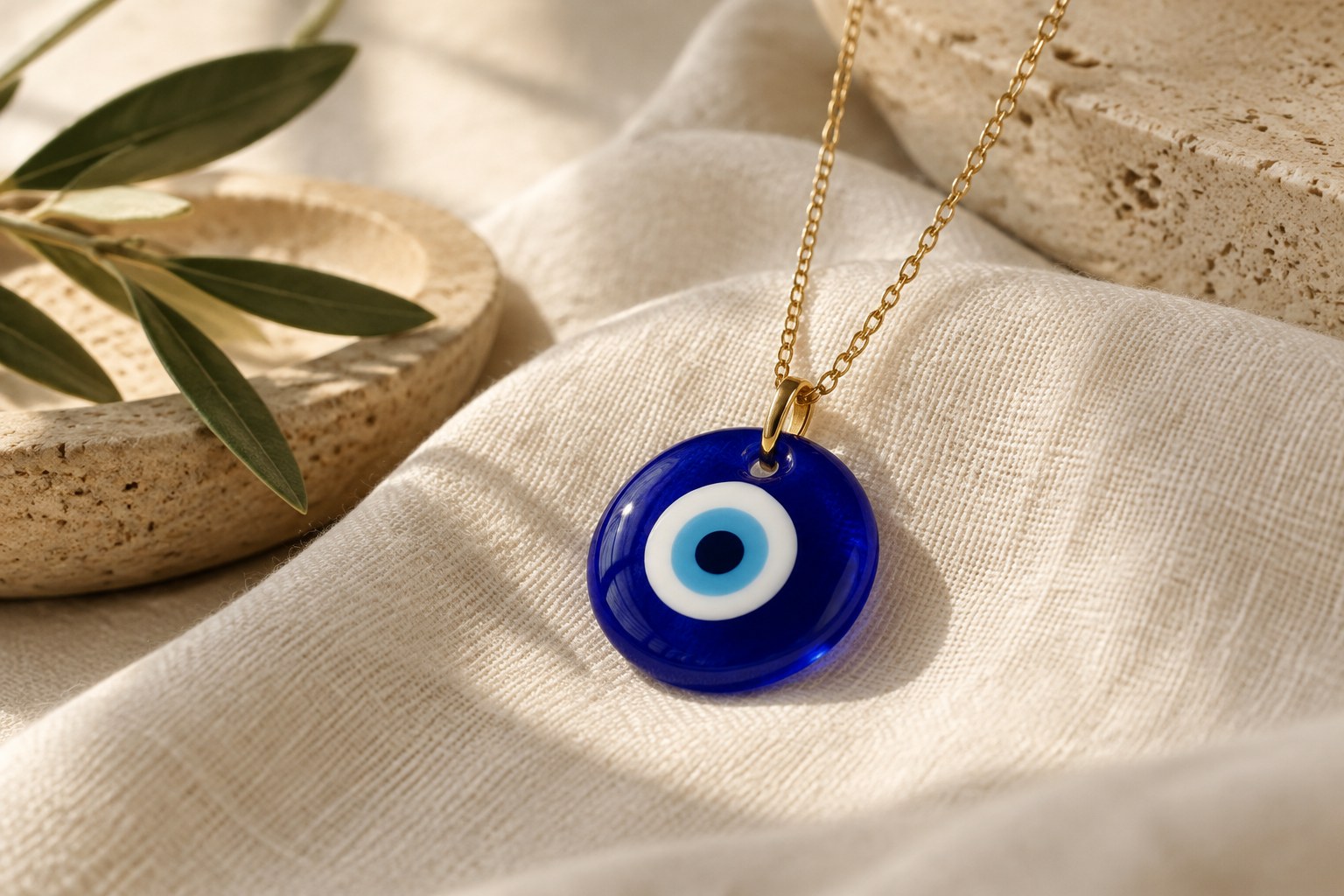
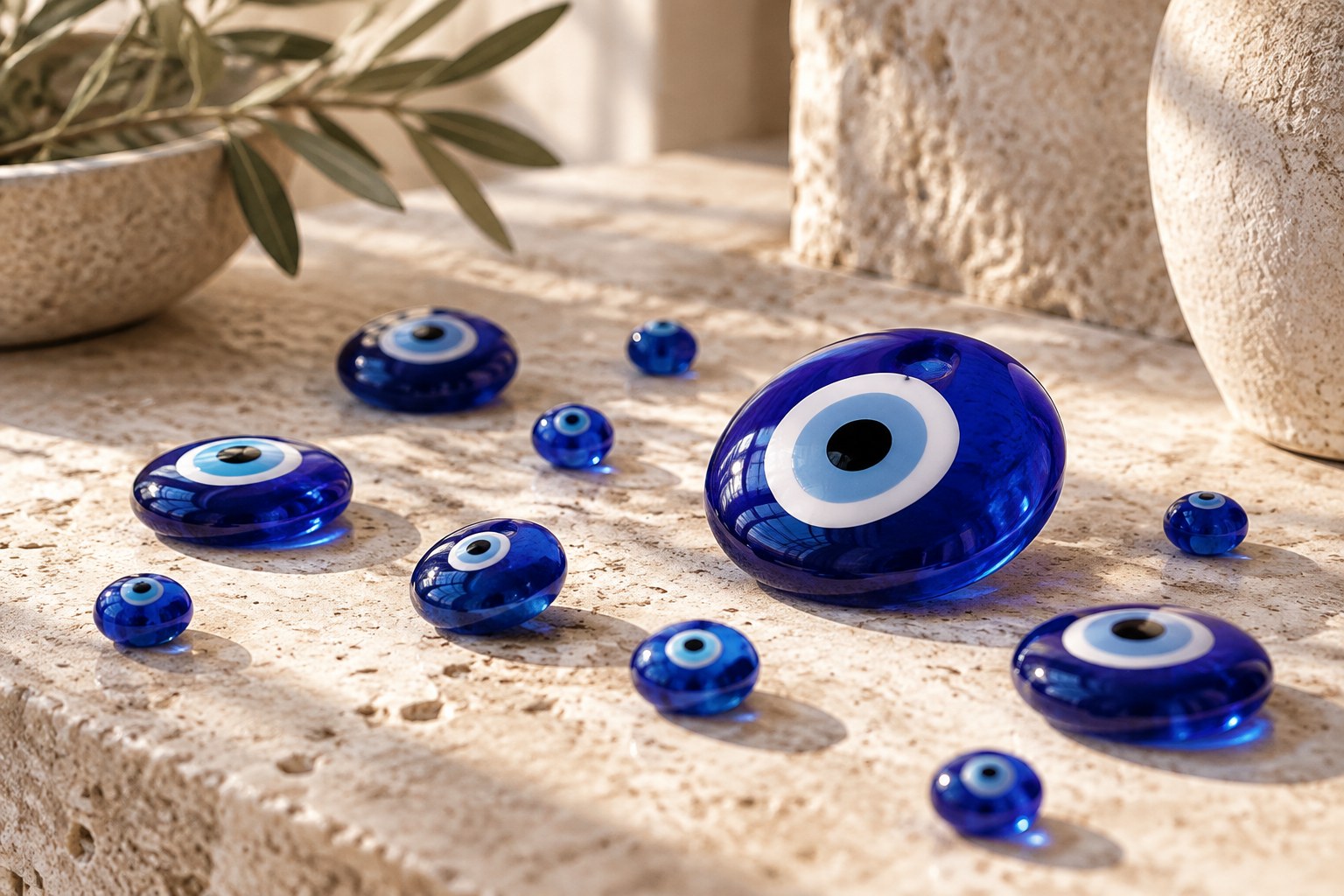
The most famous form of the amulet is the nazar: a round bead of cobalt blue glass with concentric circles of white, light blue and black, staring like an eye. It hangs in homes, cars and doorways across Turkey and Greece, and it translates beautifully into jewellery. It is not alone. The hamsa, a hand-shaped amulet, offers similar protection across North Africa and the Middle East. In Italy, the twisted horn cornicello does related work. Different hands, same human instinct: carry something that watches out for you.
AI-generated illustration; not a Shewah product or a scale measurement.
SHEWAH Editorial Concept Illustration (Non-Catalogue)
Why we still wear it
The belief spans the Mediterranean, the Balkans, West and South Asia, Latin America and beyond, and it has never really faded. Celebrity adoption brought the motif to red carpets and bracelet stacks in recent decades, but the deeper appeal is unchanged. An evil eye pendant or bracelet is jewellery with a job: it says I am looking after you. That is why it is one of the most meaningful gifts one person can give another, especially at beginnings: a new baby, a new home, a new chapter. You do not have to believe in curses to appreciate five millennia of good wishes.
Wearing the eye today
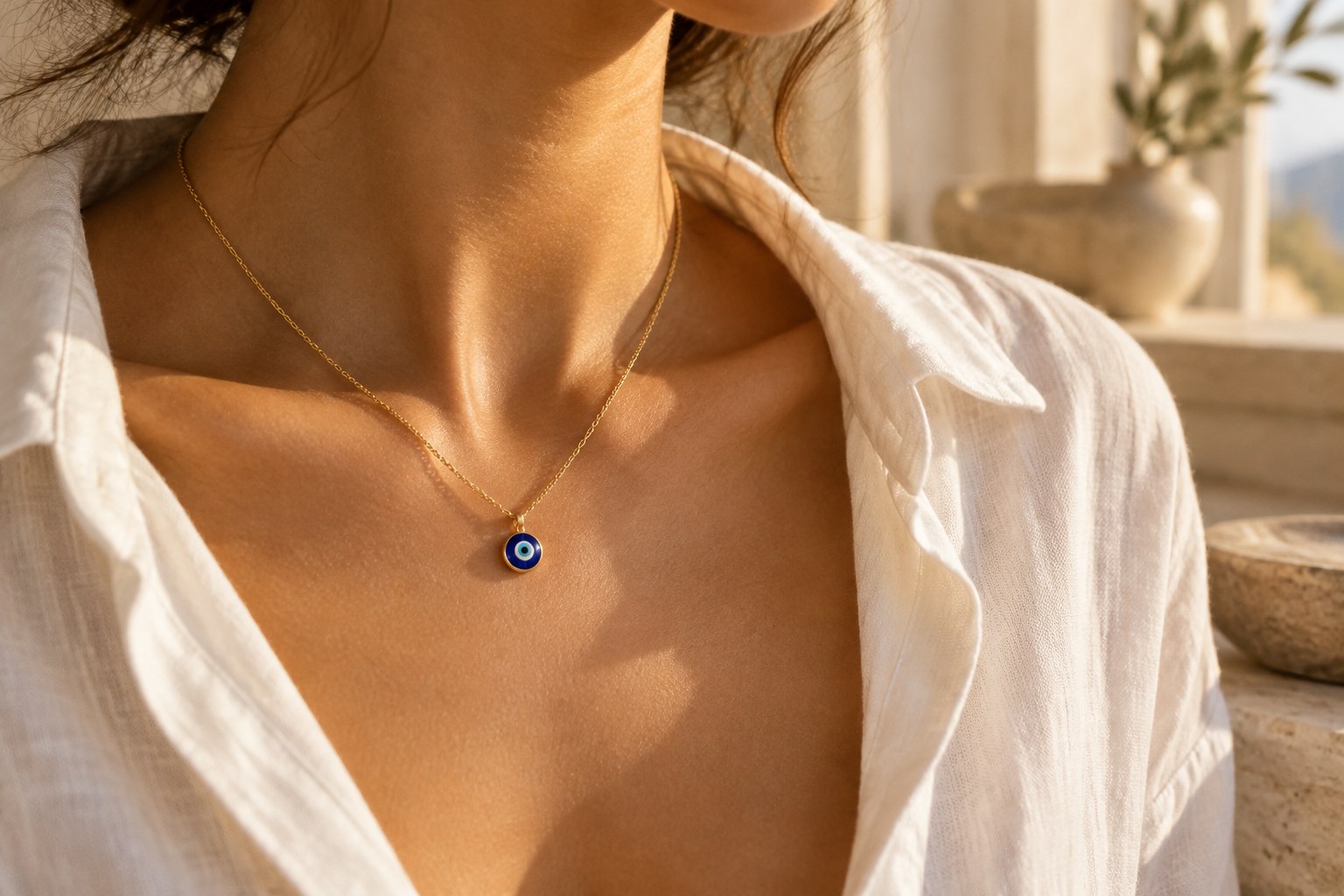
The motif slips easily into a modern collection. A small nazar pendant on a fine gold chain sits quietly against the collarbone; an eye charm on a bracelet keeps the symbol at your wrist, where you can see it. Cobalt blue glass and enamel play well with yellow gold, while diamond-set versions turn the ancient amulet into something quietly luxurious. Some wearers keep the eye visible; others tuck it under a collar, because the point is not display but company. Either way, the amulet works best as a daily piece, the kind you put on and rarely take off.
Carry a little protection with Shewah
Shewah crafts protective motif pendants and bracelets in solid gold with certified lab-grown diamonds, made to order in Surat and shipped to the US, UK and Australia. Explore Shewah's jewellery or message us on WhatsApp at +91 96622 66360 to create an evil eye piece for someone you want to keep safe.
AI-generated illustration; not a Shewah product or a scale measurement.
SHEWAH Editorial Concept Illustration (Non-Catalogue)
Sources
The Maison Shewah Atelier Standard
Every creation referenced across our journal essays is made individually to order using solid 18K gold and independently certified diamonds (IGI & GIA). We uphold complete material transparency and zero synthetic plating.
Research & Gemological References
- [1]The strange power of the 'evil eye' — BBC Culture (Verified: 2026-10-22)
- [2]Evil eye — Wikipedia (Verified: 2026-10-22)


