Are Lab-Grown Diamonds Real Diamonds? The Straight Answer
“Not an imitation, not a simulant: what the FTC rule book and gem labs say about lab-grown diamonds, and why the price differs from mined.”

AI-generated illustration; not a Shewah product or a scale measurement.
SHEWAH Editorial Concept Illustration (Non-Catalogue)
Yes. A lab-grown diamond is a real diamond. It is not an imitation, not a simulant like cubic zirconia or moissanite, and not a "fake" anything. It is crystallised carbon with the same atomic structure, the same hardness, the same brilliance and the same chemical behaviour as a diamond formed underground. The only difference is where it grew: in a machine over weeks, instead of in the earth over millennia.
Here is what that means in law, in the laboratory and for your wallet.
What the law says
The United States Federal Trade Commission settles the question in its industry guides, codified at 16 CFR 23.12. The rule defines a diamond as "a mineral consisting essentially of pure carbon crystallized in the isometric system," with a hardness of 10, a specific gravity of about 3.52 and a refractive index of 2.42. Nothing in the definition says the carbon must come out of the ground.
The same rule book requires honesty about origin: sellers must qualify laboratory-grown stones with clear terms such as "laboratory-grown" or "laboratory-created." So the legal position is simple. A lab-grown diamond is a diamond, full stop, and it must be described as laboratory-grown so buyers know its origin. Both things are true at once.
What the laboratory sees
Gem laboratories do not grade lab-grown diamonds as a separate species. IGI, which began grading laboratory-grown diamonds in 2005, screens every submitted stone to determine whether it is naturally mined, laboratory grown or a simulant, and then assesses it with the same gemological toolkit used for any diamond.
Under magnification, a trained gemologist can usually identify lab-grown stones by their growth patterns: the layered or metallic inclusions left by the two growth methods, HPHT (high pressure, high temperature) and CVD (chemical vapour deposition). These are fingerprints of origin, not flaws in the diamond itself. To the naked eye, and to every test of hardness, sparkle and wear, a lab-grown diamond behaves exactly like a mined one.
How a lab-grown diamond is different from a simulant
This is the confusion worth clearing up. Cubic zirconia and moissanite only look like diamond. They are different materials with different chemistry, different hardness and different light behaviour. A lab-grown diamond is not in that category at all: it is the same material as a mined diamond, atom for atom. That is why the FTC bars calling simulants "diamond" without qualification, while lab-grown stones simply carry an origin disclosure.
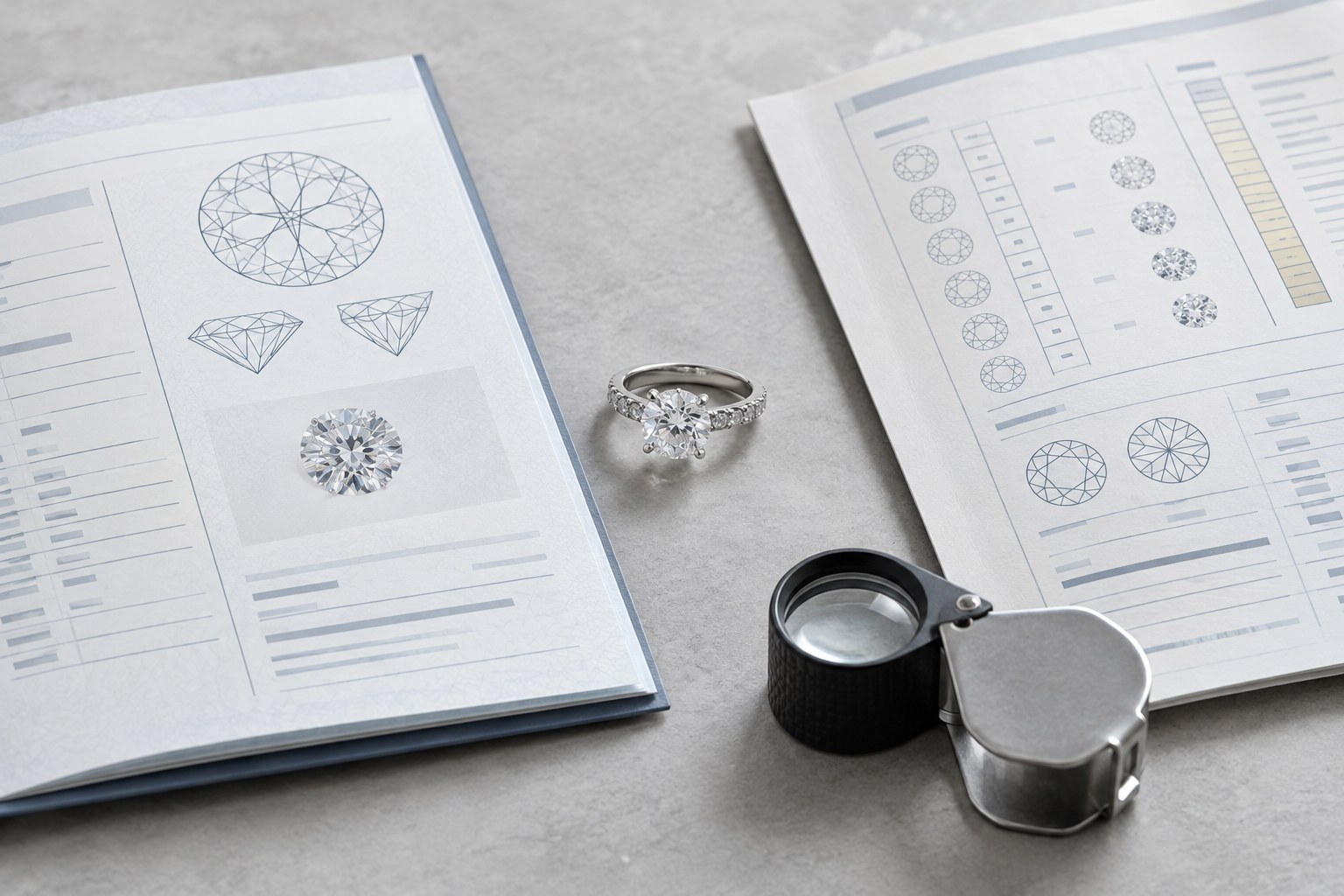
AI-generated illustration; not a Shewah product or a scale measurement.
SHEWAH Editorial Concept Illustration (Non-Catalogue)
Why the price is different
If they are the same material, why does a lab-grown diamond cost so much less? Because rarity, not quality, drives the mined-diamond price. Producing a one-carat lab-grown stone takes weeks in a facility that can run continuously, while mined supply is finite and expensive to extract. A one-carat lab-grown diamond of fine quality might retail around $800 to $1,500, where a comparable mined stone can run $4,000 to $6,000 or more. You are paying less because supply is abundant, not because the stone is lesser.
Are lab-grown diamonds the right choice?
If you want a real diamond's look, hardness and daily-wear durability at a lower price, with a transparent, certified origin, lab-grown is the straightforward answer. If long-term resale value or geological romance matters more to you, mined stones carry that story. Neither choice is wrong. What matters is knowing exactly what you are buying, with a certificate to match.
Create your lab-grown diamond ring with Shewah
Every Shewah ring is built around certified lab-grown diamonds, quoted in full before work begins.
Explore Shewah's jewellery or contact us on WhatsApp at +91 96622 66360 to discuss your design.
AI-generated illustration; not a Shewah product or a scale measurement.
SHEWAH Editorial Concept Illustration (Non-Catalogue)
Sources
- 16 CFR 23.12: Definition and misuse of the word "diamond" - eCFR (US Federal Trade Commission rules)
- Laboratory Grown Diamond Report - IGI
The Maison Shewah Atelier Standard
Every creation referenced across our journal essays is made individually to order using solid 18K gold and independently certified diamonds (IGI & GIA). We uphold complete material transparency and zero synthetic plating.
Research & Gemological References
- [1]16 CFR 23.12: Definition and misuse of the word diamond — eCFR (US Federal Trade Commission rules) (Verified: 2026-10-15)
- [2]Laboratory Grown Diamond Report — IGI (Verified: 2026-10-15)


