Amethyst Meaning, Properties and Buying Guide
“February's birthstone and the most valued quartz: what amethyst is, the truth behind the calm-and-clarity story, and how to choose a good stone.”

AI-generated illustration; not a Shewah product or a scale measurement.
SHEWAH Editorial Concept Illustration (Non-Catalogue)
Amethyst is the gemstone that makes purple democratic: beautiful enough for crown jewels, affordable enough for a first piece of real jewellery. If you are drawn to it, here is what it actually is, what the old stories say, and how to choose a good one, with the facts grounded in GIA's gem encyclopedia.
What amethyst actually is
Amethyst is the purple variety of quartz, one of the most abundant gem minerals on earth. It rates 7 on the Mohs hardness scale, which makes it tough enough for rings worn daily as well as pendants and earrings. The finest colour is a strong reddish purple to purple with no visible colour zoning, and it is the most valued variety in the whole quartz family.
That was not always so. Until large Brazilian deposits were discovered in the nineteenth century, amethyst was priced alongside ruby and emerald. Abundance made it affordable; the colour kept it desirable.
The meaning behind it
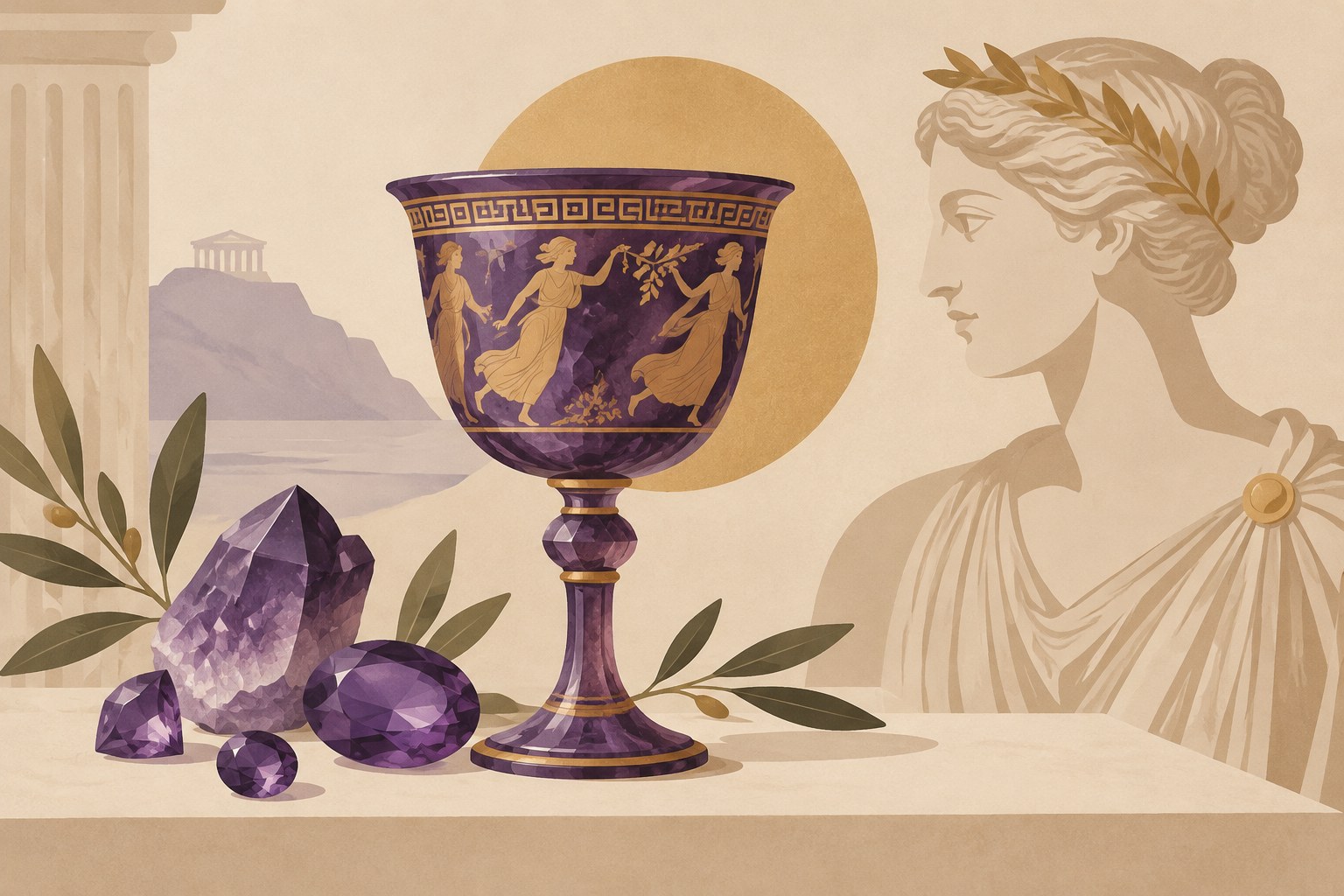
The name gives the story away: amethystos is ancient Greek for "not drunk", and the Greeks and Romans believed the stone protected its wearer from intoxication. Over the centuries that idea broadened into associations with clear-headedness, calm and balance, which is why amethyst still turns up in meditation spaces and on bedside tables.
We will be honest with you: these are stories, not established properties. What is verifiable is that purple has signalled royalty for millennia, and that amethyst has carried that symbolism from bishop's rings to crown jewels. If the calm-and-clarity meaning speaks to you, that is a lovely reason to wear it. Just buy it for the beauty and the story, not for promised effects.
February's birthstone, and more
Amethyst is the birthstone for February and the traditional gem for the 6th and 17th wedding anniversaries, which makes it one of the most giftable stones in the calendar. In Bolivia, amethyst and citrine occasionally grow in the same crystal, producing ametrine, a natural half-purple, half-yellow curiosity.
AI-generated illustration; not a Shewah product or a scale measurement.
SHEWAH Editorial Concept Illustration (Non-Catalogue)
Choosing a good amethyst
- Colour first. Look for a rich, even purple, ideally with a reddish flash, and no visible bands of lighter and darker colour when you look through the stone.
- Expect it to be natural but ask about treatment. Some amethyst is heated to deepen or even change its colour, and lab-grown amethyst exists. Neither is a problem at the right price, as long as the seller tells you straight.
- Sizes are generous. Because rough is plentiful, large amethysts stay affordable. You can wear a genuinely big stone without a big budget, which is half the fun.
Caring for it
Amethyst is durable but not invincible. Clean it with warm water, mild soap and a soft brush, and keep it out of prolonged strong sunlight, which can fade some stones. Store it away from harder gems like sapphire and diamond that could scratch it.
Amethyst in jewellery: where it shines
Amethyst's affordability in large sizes makes it one of the few gems where a bold cocktail ring or a substantial pendant is a realistic, unshowy purchase. It takes well to both cabochon and faceted cuts, looks cooler against white metals and richer against yellow gold, and holds up to daily wear as long as you treat it like the 7-hardness stone it is: tough, but not diamond-tough.
Crafted around your stone with Shewah
Tell us the shade of purple you love, deep royal or soft lilac, and we will make your amethyst piece to order, quoted in full before work begins.
Explore Shewah's jewellery or contact us on WhatsApp at +91 96622 66360 to talk stones.
AI-generated illustration; not a Shewah product or a scale measurement.
SHEWAH Editorial Concept Illustration (Non-Catalogue)
Sources
- Amethyst Gemstone - GIA
The Maison Shewah Atelier Standard
Every creation referenced across our journal essays is made individually to order using solid 18K gold and independently certified diamonds (IGI & GIA). We uphold complete material transparency and zero synthetic plating.
Research & Gemological References
- [1]Amethyst Gemstone — GIA (Verified: 2026-10-17)


